
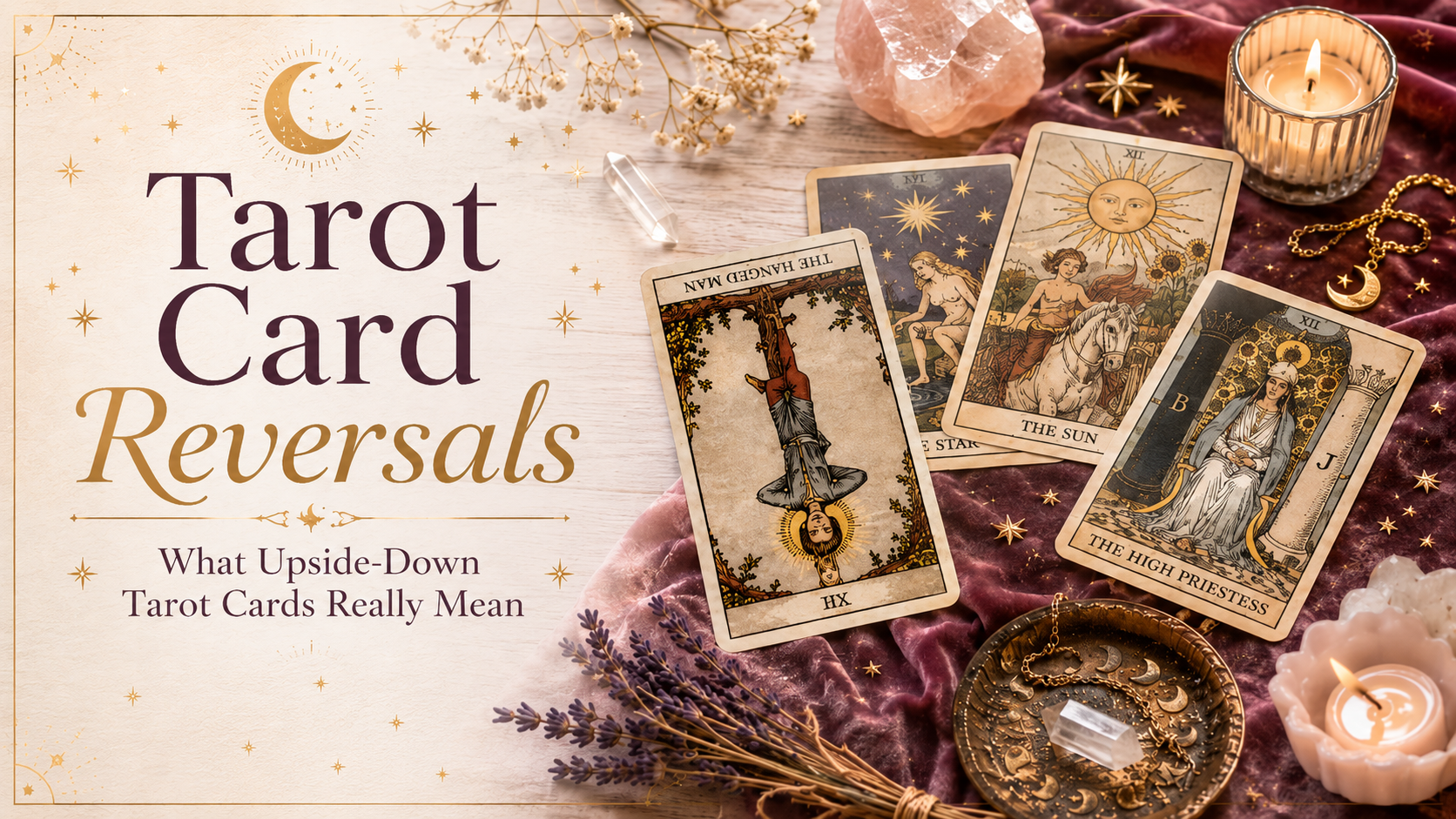
You shuffle the deck, lay out the tarot cards, and turn one over.
The card is upside down.
For many new tarot readers, a reversed card can immediately feel alarming. It may seem like the card’s positive meaning has suddenly become negative, or that the reading is warning of something terrible.
That is not necessarily true.
Tarot card reversals are more nuanced than simply turning a card’s meaning into its opposite. A reversed card can point to blocked energy, an internal struggle, a delay, an imbalance, or something that has not yet been fully recognized.
Reversals add another layer to a tarot reading. They invite you to slow down, look beneath the surface, and consider how the card’s energy is being expressed.
What Is a Tarot Card Reversal?
A tarot card reversal occurs when a card appears upside down in a reading.
Some tarot readers intentionally shuffle their decks in a way that allows cards to turn in different directions. Others keep every card upright and do not read reversals at all.
Both approaches are valid.
Tarot is not governed by one universal set of rules. A reader’s method develops through study, experience, intuition, and their relationship with the cards.
The important thing is consistency. Decide how you will work with reversals before beginning the reading instead of changing your method because you dislike a particular card.
Reversed Does Not Automatically Mean Negative
One of the biggest misconceptions about reversed tarot cards is that they always predict something bad.
They do not.
An upright card can carry difficult energy, and a reversed card can sometimes show improvement, release, or the ending of a difficult period.
For example, the upright Eight of Swords often represents feeling trapped, restricted, or powerless. Reversed, it may show that someone is beginning to recognize their options and free themselves from limiting beliefs.
The reversed Devil can suggest breaking an unhealthy attachment, confronting destructive habits, or reclaiming personal power.
The reversed Ten of Swords may indicate recovery after a painful ending. The worst may be over, even if healing is still taking place.
Context matters.
Common Ways to Interpret Reversed Tarot Cards
There is no single meaning that applies to every reversed card. However, reversals often fall into several common categories.
Blocked Energy
The energy of the upright card may be present, but something is preventing it from flowing freely.
A reversed Ace of Cups, for example, could suggest emotional withdrawal, difficulty receiving love, or feelings that are being held back.
The emotion exists, but it may not be expressed openly.
Internalized Energy
Sometimes a reversal moves the card’s meaning inward.
The upright Hermit can represent intentionally stepping away from outside distractions to seek wisdom. Reversed, the card may show deep internal reflection, loneliness, or becoming too isolated.
The reversed energy may be happening privately, even if nothing appears different on the outside.
Delays or Resistance
A reversed card may indicate that movement is slower than expected.
The reversed Chariot can suggest delays, scattered focus, conflicting priorities, or difficulty maintaining control.
This does not always mean the goal will never be reached. It may mean the current approach needs to be reconsidered.
Excess or Imbalance
A reversal can reveal that the upright energy has become extreme or unbalanced.
The upright Emperor represents structure, authority, and leadership. Reversed, those qualities may become rigidity, control, stubbornness, or misuse of power.
The energy itself is not necessarily wrong. The problem may be how strongly or poorly it is being expressed.
The Opposite Meaning
In some readings, a reversed card can represent the opposite of its upright meaning.
The upright Three of Cups may show friendship, celebration, and community. Reversed, it could point to isolation, conflict within a social circle, gossip, or feeling excluded.
However, automatically choosing the opposite meaning every time can make a reading too rigid. Look at the surrounding cards before deciding.
A Need for Review
A reversal may ask you to pause and revisit something.
The reversed Judgement card can suggest avoiding self-reflection, doubting an important realization, or refusing to respond to an inner calling.
The card may be asking, “What are you not ready to acknowledge?”
How Surrounding Cards Affect a Reversal
A tarot card should rarely be interpreted in isolation.
The cards surrounding a reversal help reveal whether the energy represents a warning, an internal process, a delay, a release, or an opportunity for growth.
Imagine that the reversed Lovers appears beside the Seven of Swords. This combination could indicate dishonesty, avoidance, divided loyalties, or a relationship decision influenced by secrecy.
Now imagine the reversed Lovers beside the Hermit and Four of Swords. In that context, the card may suggest taking time apart, reflecting on personal values, or reconsidering what someone truly wants from a relationship.
The same reversed card can carry a different message depending on the question, position, spread, and surrounding cards.
Should Beginners Read Reversals?
Beginners do not have to use reversals immediately.
Learning the upright meanings of seventy-eight tarot cards already requires time and patience. Adding reversed meanings can feel like trying to memorize another entire deck.
Start with upright cards if that feels more manageable.
Even without reversals, a skilled reader can recognize blocked, hidden, excessive, or difficult energy by studying the imagery, card position, question, and surrounding cards.
When you feel comfortable with the upright meanings, you can gradually introduce reversals.
You might begin by asking three questions when a reversed card appears:
- Is this energy blocked?
- Is this energy happening internally?
- Is there too much or too little of this card’s energy?
These questions can help you interpret reversals without relying entirely on memorized definitions.
Do You Have to Read Every Reversed Card?
No.
Some readers turn reversed cards upright and interpret them according to their position in the spread. Others acknowledge that the card appeared reversed but use intuition to decide whether the reversal is meaningful.
A reversed card may sometimes result from how the deck was handled rather than carrying a special message.
Your reading practice should have structure, but it should not become so rigid that you ignore your own intuition.
The goal is not to force every card into a fixed definition. The goal is to understand what the cards are communicating as a complete story.
A Simple Exercise for Learning Reversals
Choose one tarot card and study its upright meaning.
Write down the card’s main energy, including its strengths, challenges, emotions, and possible actions.
Then turn the card upside down and ask:
- What would this energy look like if it were blocked?
- What would it look like if it were hidden?
- What would happen if there were too much of it?
- What would happen if there were too little of it?
- Could this reversal represent healing or release?
- What might someone be resisting?
For example, consider the Queen of Wands.
Upright, she may represent confidence, creativity, warmth, independence, and personal magnetism.
Reversed, she might show insecurity, jealousy, self-doubt, attention-seeking behavior, creative frustration, or a loss of confidence.
She could also represent a confident person who is privately struggling, even though others do not see it.
This exercise helps you understand the energy behind the card rather than memorizing a list of keywords.
Trust the Message, Not the Fear
A reversed card is not automatically a punishment, disaster, or prediction of failure.
It is often an invitation to look more closely.
It may reveal what is being avoided, where energy is blocked, what needs to be brought back into balance, or where healing has already begun.
When a reversed card appears, pause before assuming the worst.
Study the imagery. Consider the question. Examine the surrounding cards. Notice your first intuitive response.
Tarot reversals do not exist to frighten you. They offer another perspective, and sometimes that different perspective is exactly what the reading needs.
Reversals aren’t limited to numbered cards. They can show up in Court Cards too, adding another layer to how a King, Queen, Knight, or Page is expressing their energy. And reversals are just one more thread in tarot’s larger symbolic language, the kind of layered reading you’ll see more of in the Tarot Symbolism Series.
Final Thoughts
There is no rule requiring every tarot reader to use reversals.
Some readers find that reversed cards bring greater depth and precision to their readings. Others receive clear, detailed messages using upright cards only.
Neither method is more legitimate than the other.
The best approach is the one that allows you to read with clarity, consistency, honesty, and trust in your connection with the cards.
Tarot is not simply about whether a card is upright or reversed. It is about understanding the energy, recognizing the pattern, and listening carefully to the story unfolding before you.
What are your thoughts about reading tarot card reversals?
Kim
Kim’s Esoteric Tarot Journals
 Kim's Esoteric Tarot Journals
