
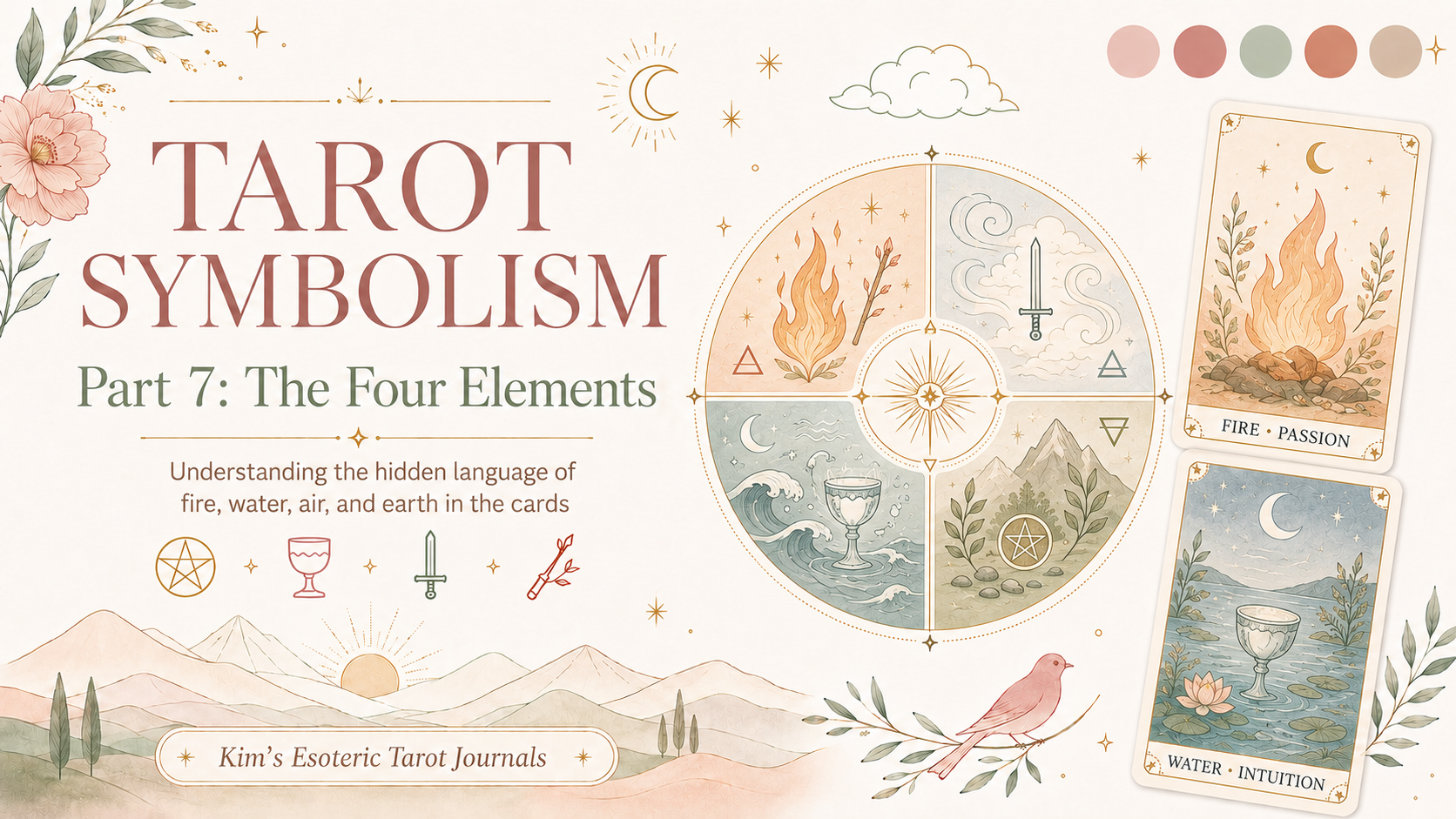
Tarot Symbolism 107: Fire, Water, Air, and Earth in the Cards
We have worked through six layers of tarot symbolism so far: numerology, color, direction and body language, clouds and weather, animals, and plants and flowers. Today we are covering the layer that sits underneath all of the others: the four elements. Fire, Water, Air, and Earth are the foundation the entire tarot deck is built on. Understanding them does not just help you read individual symbols. It helps you understand why the deck is structured the way it is.
Every one of the four suits in the Minor Arcana is assigned to an element, and that assignment shapes every card in that suit from the Ace all the way through the King. The elements also appear visually throughout the Major Arcana in ways that most people walk right past. Once you know what to look for, you will start to see elemental language running through every card in the deck.
The Four Elements and the Four Suits
Here is the core assignment every tarot reader works from. These are not arbitrary. Each element was chosen because its essential qualities match the territory its suit covers.
| Element | Suit | Core Energy | What It Governs |
| Fire | Wands | Passion and will | Ambition, creativity, inspiration, drive, and the spark that starts things |
| Water | Cups | Feeling and flow | Emotions, relationships, intuition, dreams, and the inner life |
| Air | Swords | Thought and truth | The mind, communication, conflict, clarity, and the double edge of intellect |
| Earth | Pentacles | Matter and form | Money, work, the body, physical security, and the tangible results of effort |
This is why I always tell beginners to learn the elements before they try to memorize individual card meanings. If you know that Swords belong to Air, you already know that every Swords card will have something to do with the mind, with thought, with communication, or with conflict. That is fourteen cards you understand before you have looked at a single one of them individually. The element gives you the territory. The number or court rank tells you where in that territory you are.
How the Elements Appear Visually
Beyond the suit system, the four elements show up as visual details throughout the deck. Here is a quick reference for the most common elemental signs to look for in the imagery itself.
| Visual Sign | Element | What to Look For |
| Flames or torches | Fire | Active energy, transformation, urgency, or creative force at work |
| Rivers, rain, or sea | Water | Emotional currents, the unconscious, intuition, or situations in flow |
| Clouds, wind, or birds | Air | Mental activity, communication, shifting conditions, or ideas in motion |
| Mountains or stone | Earth | Stability, permanence, challenge requiring effort, or things built to last |
| Wands or staffs | Fire | Initiative, personal power, and the will to create or lead |
| Cups or vessels | Water | Emotional content, what is being held, offered, or poured out |
| Swords or blades | Air | Intellect, conflict, truth-telling, and the consequences of clear thinking |
| Coins or discs | Earth | Resources, material value, work in progress, and tangible outcomes |
The Elements in the Major Arcana
The Major Arcana does not belong to any single suit, but elemental energy runs through it constantly. The Emperor is deeply associated with Fire in its commanding, initiating energy, even though no flames appear in the card. The High Priestess is Water through and through: still, deep, inward, and concerned with what lies beneath the surface. The Fool steps into Air the moment he leaps, carried by wind, ungrounded, entirely in the realm of possibility. The Hierophant and the World both carry strong Earth associations: structured, established, and concerned with the tangible forms that things take in the world.
You do not need to memorize every elemental association in the Major Arcana before you start reading. But when a Major card feels unclear, asking yourself which element is most present in its imagery is often the fastest way back to the card’s essential meaning.
Quick Examples
The Three of Wands shows a figure standing on high ground, watching ships cross open water. The wands themselves are Fire, and the figure’s posture is forward-looking and expansive. But the water below represents something the Fire energy must work with or move across. The card is not just about ambition and vision. It is about what Fire looks like when it meets the larger world and has to navigate it. The elemental contrast in the image is part of the meaning.
The Queen of Cups sits at the edge of the sea, holding an ornate covered cup. Everything in her card is Water: her throne, the sea behind her, the clouds, the cup she holds but does not open. She is entirely in her element, which is why she represents emotional mastery rather than emotional struggle. A court card sitting comfortably within its own element is almost always a card about someone who knows their own nature well.
The Five of Swords has clouds in a disturbed sky and a figure holding three swords while two others walk away. The Air element is present throughout: the swords, the unsettled sky, the sense that something has been said that cannot be unsaid. The conflict in this card is not physical. It is intellectual and communicative, which is exactly what Air conflict looks like.
The Ten of Pentacles shows a multigenerational family scene in front of an archway covered in pentacles. The Earth element is everywhere: the stone architecture, the settled domestic scene, the weight of accumulated material success. The card does not need flames or water or wind. It needs permanence, and Earth provides it completely.
How to Use This When You Read
When you look at a card, try running a quick elemental check before you reach for a specific meaning:
• Which element does this card’s suit belong to, and what does that tell you about the territory the situation lives in?
• What elemental imagery is visible in the card, and does it reinforce or complicate the suit’s element?
• Is one element dominating your spread, or are all four represented?
• Are any elements completely absent from your spread?
A spread dominated by one element is always worth noting. A reading full of Fire cards is telling you something about energy, urgency, and creative or passionate force driving the situation. A reading full of Water cards is pointing toward an emotionally complex situation where feelings are doing most of the work. A reading with very little Earth is often one where the practical, tangible aspects of a situation have not been addressed yet.
The four elements are the grammar of tarot. Every other layer of symbolism we have covered in this series builds on top of them. Keep them in mind as you work through the remaining parts of this series, because they will show up again in the celestial symbols, the landscapes, and the repeated patterns we still have to cover.
Coming Up Next
Next we look upward again, this time at celestial symbols: the sun, the moon, the stars, and the planets that appear throughout the Rider-Waite deck. Celestial imagery carries a specific kind of symbolic weight that is different from the weather and atmosphere we covered in Part 4, and it is worth giving it its own dedicated space. After celestial symbols, the series continues through clothing, objects, landscapes and buildings, and repeated symbols.
Have you started thinking about the elements in your readings? If so, what are your thoughts?
Tarot readings are intended for adults age 18 and older and are provided for entertainment and personal reflection. Tarot should not replace professional medical, legal, mental health, or financial advice.
© 2026 Kim’s Esoteric Tarot Journals. All rights reserved.
 Kim's Esoteric Tarot Journals
