
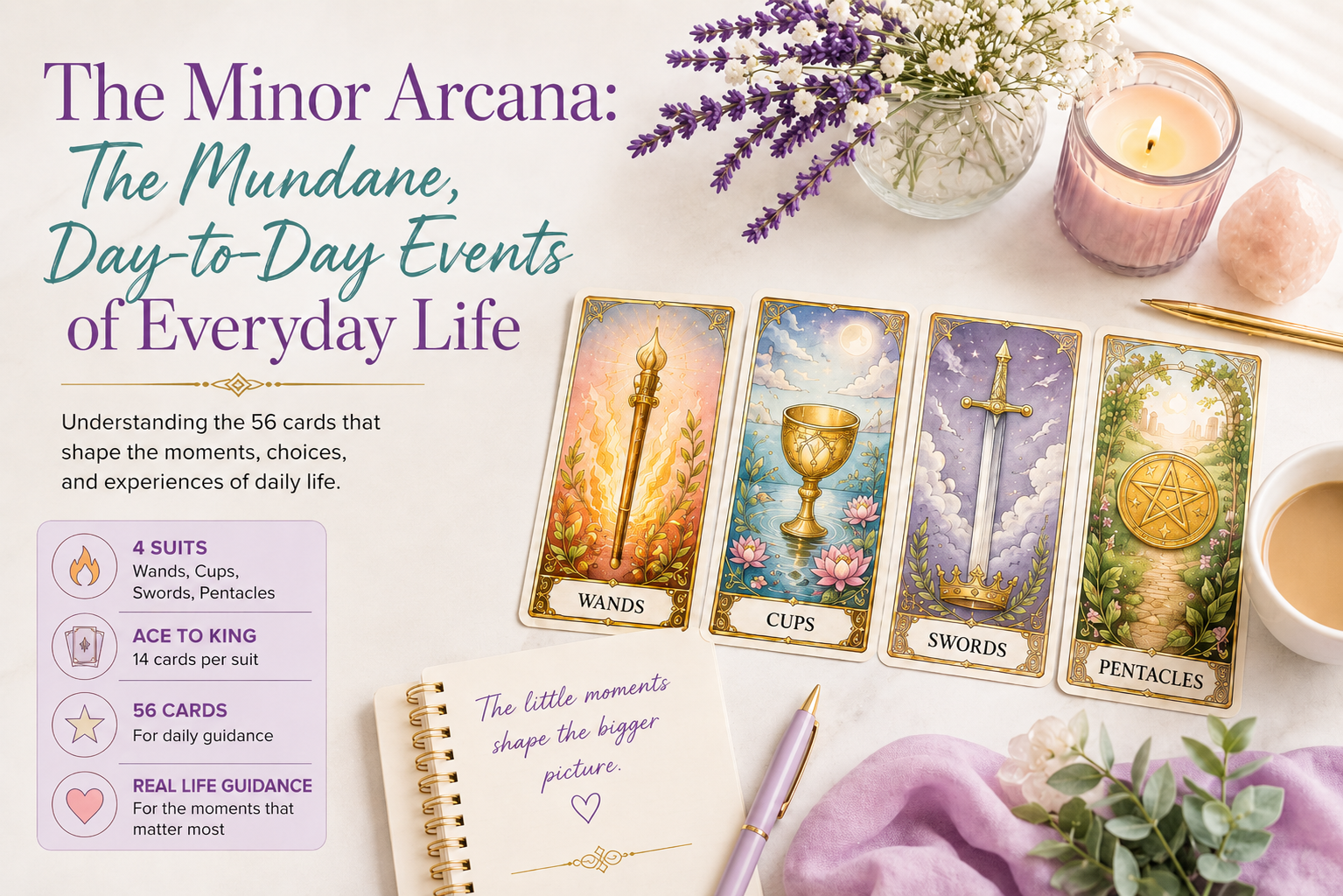
Last time, we slowed down inside the Major Arcana and walked the Fool’s Journey from card 0 to card 21. If you missed it, the short version is this: those twenty-two cards describe the big stuff, the turning points and defining moments that mark a real before and after in someone’s life. Today we’re turning to the other half of the deck, the fifty-six cards that make up the Minor Arcana, the ones I tell my clients to think of as the texture of daily life rather than its headlines.
What Makes the Minor Arcana Different
If the Major Arcana is the chapter titles of your story, the Minor Arcana is everything written on the pages in between. These cards don’t carry the weight of fate or transformation the way The Tower or Death do. Instead, they speak to the week you’re having: a conversation that didn’t go the way you hoped, a financial decision you’re sitting with, the mood that’s been following you around since Tuesday. When a Minor Arcana card turns up in a reading, I don’t ask my clients to sit up straighter the way I do with the Majors. I ask them to think about what’s actually happening in their life right now, because that’s almost always where the answer is hiding.
The fifty-six Minor Arcana cards are organized into four suits: Wands, Cups, Swords, and Pentacles. Each suit is tied to one of the four classical elements, and that elemental association tells you almost everything you need to know about what a suit is “about” before you ever look at a single card from it.
The Four Suits
Here are the four suits and the element each one carries. I won’t list all fifty-six cards individually today; that’s what the suit-by-suit posts coming up will be for, but understanding these four building blocks is really the heart of reading the Minor Arcana well.
Wands: Fire. The suit of passion, ambition, and creative spark. Wands cards show up around action, energy, and the early, electric stage of any new idea or undertaking.
Cups: Water. The suit of feeling. Cups cards live in the emotional and relational parts of life: love, intuition, connection, and the inner world we don’t always say out loud.
Swords: Air. The suit of the mind. Swords cards deal in thought, truth, conflict, and communication, the sharp-edged clarity that comes from facing something head-on.
Pentacles: Earth. The suit of the material world. Pentacles cards govern money, work, health, and the tangible, grounded results of our day-to-day effort.
Each of these four suits is built the same way: every suit runs from the Ace through the King, fourteen cards in total, which is where you get fifty-six cards across all four suits. Once you understand how one suit is built, you understand the architecture of the entire Minor Arcana, which is really what I want to leave you with today.
Inside Each Suit: Ace Through King
Within every suit, the numbered cards run Ace through Ten, and they tell one continuous story, the same way the Major Arcana does, just on a smaller, more personal scale. The Ace is the spark: a new opportunity arriving in whatever form that suit takes, pure potential and nothing built yet. From there, the Two through Ten trace that spark through choices, partnerships, setbacks, and effort, until the Ten arrives as a kind of small completion, the natural endpoint of whatever that suit set out to do.
After the Ten, each suit shifts into four court cards: the Page, the Knight, the Queen, and the King. These aren’t part of that numbered arc; they’re something different entirely, closer to people than to events. The court cards represent personalities, roles, or even actual people who might be relevant to your reading, each one carrying the qualities of their suit but expressed through a particular kind of presence and maturity. A King of Wands and a King of Cups, for instance, are both “Kings,” but they lead in completely different ways, one through fire and the other through feeling. The court cards genuinely deserve a post of their own to do them justice, so I’ll be giving them that dedicated treatment once we’ve made our way through the numbered cards, suit by suit.
So to recap the shape of it: four suits, each one running Ace through King, fourteen cards per suit, fifty-six cards in total. That’s the entire architecture of the Minor Arcana, and from here, every individual card is really just that suit’s element, expressed at a particular point along its own Ace-to-King story.
Reading the Suits as a Whole
The way I read it for my clients: notice which suit is dominant in a spread before you even look at the individual cards. A reading full of Swords is going to feel very different from one full of Cups, even before you know which specific cards showed up. Ask yourself which element is asking for your attention right now. Is this a Wands moment, all fire and forward motion? A Cups moment, asking you to sit with what you feel? A Swords moment, demanding clarity or a hard truth? Or a Pentacles moment, rooted in the practical and the material? That question will orient you long before you get into the specifics of any single card.
In the weeks ahead, I’ll move through each suit individually, Ace through Ten, and then give the court cards the dedicated post they deserve, the same way I’m already working through the Major Arcana one card at a time. For now, consider this your map of the Minor Arcana’s structure. The deeper conversations, as always, are coming.
Kim’s Esoteric Tarot Journals
 Kim's Esoteric Tarot Journals
