
We have now completed our twelve-part Tarot Symbolism Series. Whether it refreshed what you already knew or gave you a few new takeaways to carry into your own readings, I hope you enjoyed working through the series. Before we move into interpreting individual tarot cards, starting with the Major Arcana, I want to first address reading tarot cards upright and reversed. Not everyone reads reversals, and you are certainly not required to. Reading reversals, however, can add another layer of depth to your readings.
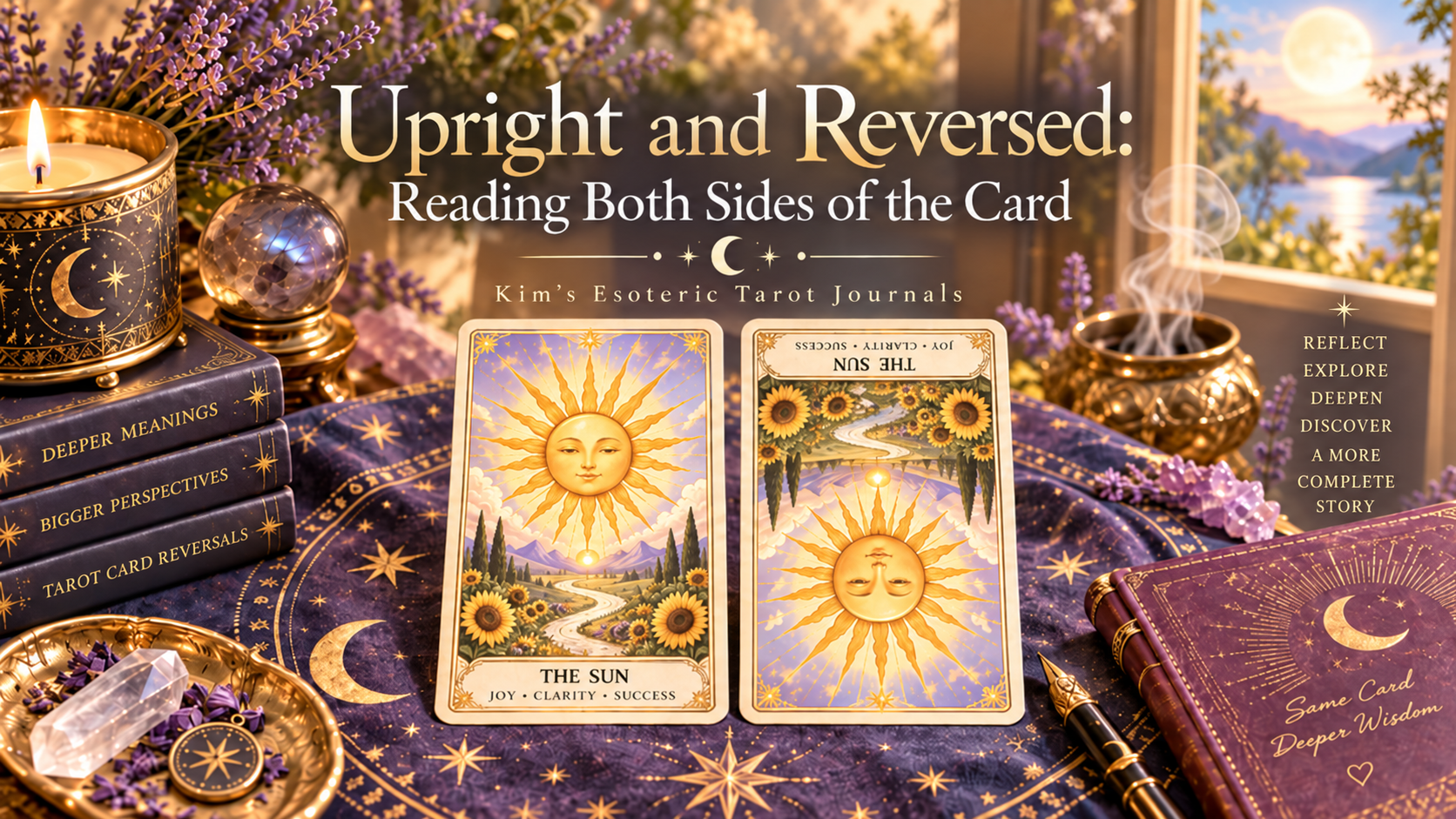
If you have ever pulled a card and watched it land upside down in your spread, you already know the small jolt of uncertainty that follows. Do you turn it right-side up and read it as usual? Do you sigh and brace for bad news? Almost every reader asks this question at some point, and the honest answer is that reversals are one of the most misunderstood parts of tarot practice. They are not complicated once you understand what they are actually doing. The cards just need a little unpacking.
This post walks through upright and reversed meanings in plain language, without turning it into a memorization exercise. By the end, you should have a simple, steady way of thinking about reversals that you can carry into every reading from here forward.
What an Upright Card Is Really Telling You What an Upright Card Is Really Telling You
An upright card is the clearest, most direct version of its meaning. The card’s energy flows the way it naturally wants to, fully expressed and out in the open. If the Six of Wands appears upright, you are looking at recognition, success, and a win others can see. Nothing about it is hidden or held back. Reading upright cards is really just learning the base meaning of each card, since that meaning is what you see at full strength.
This is why most beginners start with upright meanings only. It gives you a solid foundation, a plain and reliable version of each card’s story, before you start layering in the more subtle question of direction.
What Changes When a Card Is Reversed
When a card comes out reversed, nothing about its core meaning disappears. The same themes, energy, and underlying story are still present. What changes is how that energy is showing up in the situation. There are three common ways experienced readers describe this shift, and you will find yourself reaching for different ones depending on the card and the question in front of you.
The first is the opposite meaning. Here, the reversed card is read as the flip side of its upright self. The Two of Cups upright speaks to a strong mutual connection, so reversed it can point to a disconnect, an imbalance, or a relationship that has grown one sided.
The second is blocked or delayed energy, and this is the lens I reach for most often in my own readings. Rather than flipping the meaning entirely, the reversed card says that the upright energy is still true and still on its way, it is just being held up. Something is slowing it down, whether that is outside circumstances, self doubt, timing, or resistance from the person or situation involved. The Six of Wands reversed, in this reading, does not mean failure. It means the recognition or success is delayed, quieter than expected, or not yet visible to others.
The third is an internal or hidden version of the upright meaning. Instead of showing up outwardly, the energy is happening privately, beneath the surface. The Three of Swords upright shows heartbreak that is out in the open and being processed. Reversed, that same heartbreak may be present but kept quiet, an old wound being worked through internally rather than shared.
None of these three lenses is the single correct way to read every reversal. Most readers move intuitively between them naturally, guided by the card itself and by the question being asked.
A Simple Way to Choose the Right Lens
If you are new to reversals, here is a starting point that keeps things simple rather than overwhelming. Look at what the upright card is fundamentally describing.
If the card describes an action or a forward movement, something like a journey, a decision, a victory, or a change taking place, a reversal will usually read most naturally as blocked or delayed energy. The movement the card describes is not happening as smoothly or as quickly as it would upright.
If the card describes an emotional state or an inner quality, something like love, fear, generosity, or grief, a reversal will usually read most naturally as that quality turned inward, suppressed, or expressed in its shadow form rather than its healthy form.
This is not a rigid rule, and tarot rarely rewards rigid rules. It is simply a place to start so that reversals stop feeling random and start feeling like an extension of the meaning you already know.
Three Examples
The Sun upright is warmth, clarity, joy, and success that is easy and unclouded. Reversed, the Sun does not become darkness. It becomes joy that is delayed or dimmed, a success that has not fully arrived yet, or happiness that is present but harder to feel right now than it should be. The light is still there. It is just partially blocked.
The Tower upright is sudden, disruptive change, the kind that tears down something that was never as stable as it looked. Reversed, the Tower often points to a collapse that is being avoided or delayed rather than one that has already happened. The instability is real and building, but the person involved may be resisting the change, bracing against it, or postponing an ending that is coming regardless.
The Six of Swords upright is a quiet, steady movement away from difficulty and toward calmer waters, a transition already underway. Reversed, that same journey is stalled. The person may be struggling to leave a difficult situation behind, feeling stuck despite knowing they need to move on, or moving through the transition much more slowly and painfully than the upright card would suggest.
A client of mine once pulled the Six of Swords reversed in a reading about a job she knew she needed to leave. She told me right away that she already understood what the card meant; she just did not understand why she still felt so stuck. That is exactly what a reversed Six of Swords so often describes. The direction is clear and the decision has already been made in her heart. What the reversal was showing was the very real friction of actually making the move, the fear, the practical obstacles, and the part of her that was still holding on. Naming that gap between knowing and doing gave her something concrete to work with, rather than a vague sense that something was wrong.
Do You Have to Read Reversals at All
No. Plenty of skilled, experienced readers choose not to use reversals and read every card upright, drawing out the shadow side or the challenge of a card from its imagery and its context in the spread rather than from its orientation. This is a completely valid way to read, and it is worth trying if reversals ever start to feel more confusing than illuminating. Tarot does not require reversals to be a legitimate or effective practice. It only requires that whatever method you choose, you use it consistently and with attention.
If you do want to work with reversals, the best way in is simply practice. Pull a card, decide which of the three lenses feels most true for that card and that moment, and read it that way. Over time you will notice patterns in your own instincts, and reversals will start to feel less like a puzzle to solve and more like another voice the deck uses to speak to you.
Reading tarot well has never been about memorizing a fixed meaning for every possible position a card can land in. It is about learning to listen closely enough that the card tells you which meaning it is offering, upright or reversed, in this reading, for this question, right now.
Thank you for reading, and for sticking with me through the wrap-up of the Symbolism Series and now into this look at reversals. Do you read reversals in your own practice, and if so, which lens do you reach for most: the opposite meaning, blocked energy, or something hidden beneath the surface? I would love to hear your thoughts.
Tarot readings are intended for adults age 18 and older and are provided for entertainment and personal reflection. Tarot should not replace professional medical, legal, mental health, or financial advice.
© 2026 Kim’s Esoteric Tarot Journals. All rights reserved.
 Kim's Esoteric Tarot Journals
