
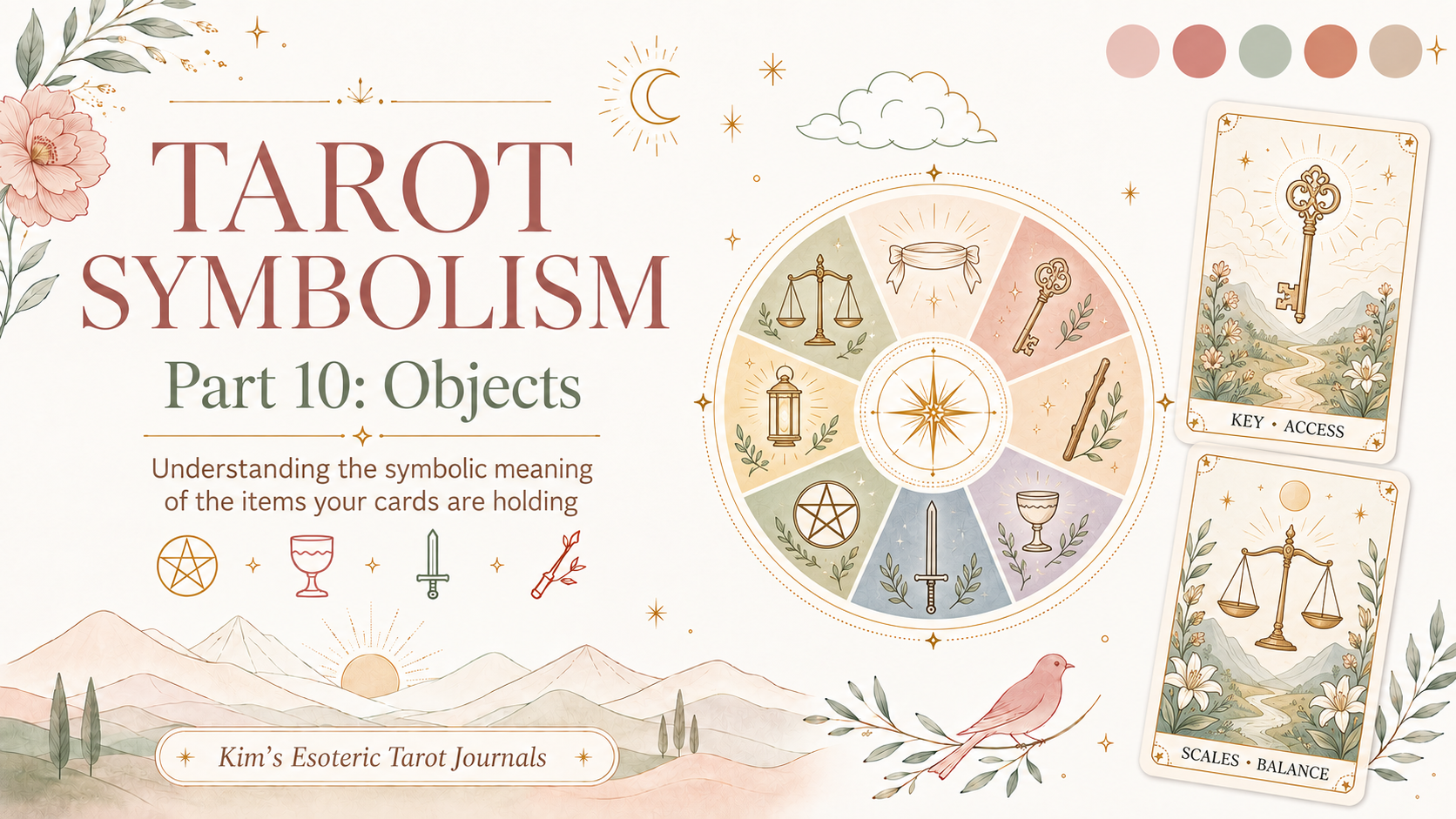
Tarot Symbolism 110: The Items Your Cards Are Holding
Nine layers of tarot symbolism are now in place. Today we are looking at objects: the specific items that figures hold, carry, or that appear as central features of a scene throughout the Rider-Waite deck. Objects are one of the most direct and precise forms of symbolic communication in tarot. Unlike color or clouds and weather, which set a tone, or direction and body language, which describes a relationship, an object usually means one thing with very little ambiguity. A set of scales means justice and balance. A blindfold means something is not being seen. A key means access to something locked. The specificity is the point.
This is also the layer where the four suits reveal themselves most literally. The wand, the cup, the sword, and the pentacle are all objects before they are symbols. When you hold the Ace of any suit, you are looking at that suit’s object in its purest, most essential form, the thing stripped of any surrounding narrative and presented simply as what it is. Learning what each suit’s object means at its core gives you a foundation that carries through every card that object appears in.
Objects as the Most Literal Layer
Every other layer of symbolism in this series has required some interpretation. A blue sky might mean calm, or it might mean something is being suppressed. A figure facing left might be retreating, or it might be reflecting. Color, atmosphere, and body language all require you to read them in context before their meaning settles.
Objects tend to be more fixed. The Hermit carries a lantern because he is a source of light for those still in the dark. The Justice card carries scales because the situation requires an honest weighing of what is true. The Wheel of Fortune holds a wheel because fate operates in cycles that no individual controls. You still read objects in context, but they give you a more stable anchor than most other symbolic elements. When an object appears in a card, it is almost always doing exactly what that object does in the real world, just at a symbolic level.
Objects Reference
Here is a quick reference for the objects most commonly found in Rider-Waite tarot cards and what each one generally brings to a reading.
| Object | Core Energy | General Meaning |
| Key | Access | Opening what is locked, the answer to a question, or permission to enter something new |
| Scales | Justice | Balance, fairness, weighing of options, and the demand for an honest reckoning |
| Lantern | Guidance | Illumination in darkness, a small but steady light, and the wisdom to find the way forward |
| Staff or wand | Authority | Personal power, direction of will, and the tool through which energy is channeled |
| Sword | Truth | Clarity, intellect, conflict, and the double edge of knowing something precisely |
| Cup or chalice | Feeling | What is being held emotionally, offered to another, or received from outside |
| Pentacle or coin | Value | Material worth, resources, the tangible result of effort, and what is being exchanged |
| Scroll or book | Knowledge | Recorded wisdom, things written and therefore fixed, and the authority of what is known |
| Torch | Passion | Active fire, the light carried forward, and energy that illuminates as it moves |
| Hourglass | Time | The passage of time, urgency, a situation with a finite window, and what cannot be rushed |
| Wheel | Cycles | Fate in motion, the turning of fortune, and the inevitability of change over time |
| Tower | Structure | Established systems, things built over time, and what happens when foundations are tested |
| Blindfold | Denial | Deliberate refusal to see, self-imposed limitation, or a situation requiring sight turned inward |
| Chains or bonds | Restriction | Limitation, obligation, bondage that may be real or self-imposed, and what holds a situation in place |
| Mirror | Reflection | Self-knowledge, truth seen directly, and the confrontation with what is actually there |
| Wreath | Honor | Achievement recognized, a cycle completed with distinction, and the reward of sustained effort |
| Rose | Desire | Beauty and passion, the thing worth reaching for, and the thorns that come with it |
| Banner or flag | Declaration | A position taken openly, victory announced, and the willingness to be seen for what one stands for |
Quick Examples
The Hermit holds both a lantern and a staff. The lantern is raised, casting light ahead of him rather than around himself, which tells you the light is meant for others, not just for his own navigation. The staff supports him but also marks him as a traveler, someone in motion through difficult terrain. Together the two objects tell the card’s story more efficiently than almost any other detail in the image: a wise figure who has done the interior work and now offers what he found to those who are ready to receive it.
Justice holds scales in one hand and a raised sword in the other. The scales represent the act of weighing: nothing decided until everything has been considered. The sword represents the act of cutting through to the truth once the weighing is done. The two objects work together as a sequence. First the scales, then the sword. Fair consideration, then decisive clarity. One without the other would tell an incomplete story, and the card holds both on purpose.
The Two of Swords shows a seated figure holding two crossed swords in front of her chest, with a blindfold over her eyes. Three objects working together: the blindfold preventing sight, the crossed swords preventing passage, and the posture of the arms preventing anything from getting through. Every object in the card reinforces the same message from a different angle. The situation is blocked in every direction, and the figure is the one doing the blocking.
The Ace of Cups shows a single ornate cup overflowing with five streams of water, a dove descending into it from above, and a hand emerging from a cloud to offer it. The cup is the object, and it is doing everything cups do in their most essential form: receiving, holding, and offering feeling. The overflowing streams tell you there is more here than can be contained. The dove tells you the source is divine. The offering hand tells you this is available, not yet taken. That one object, read carefully, delivers the entire meaning of the card.
How to Use This When You Read
When an object appears in a card, take a moment to read it on its own before you fold it into the larger card meaning:
• What is the object, and what does it do in the real world?
• What is the figure doing with the object: holding it, offering it, ignoring it, wielding it?
• Is the object in good condition, damaged, or incomplete?
• Is the same object appearing in more than one card in your spread?
• Does the object reinforce the card’s traditional meaning, or does it add a layer the name alone does not capture?
What a figure does with an object matters as much as what the object is. A sword raised in triumph and a sword pointed at a prone figure are the same object doing completely different things. A cup being offered openly and a cup being clutched tightly to the chest are the same object in entirely different emotional registers. Always read the action alongside the item.
Objects are meant to add precision and clarity to a reading, not override the card’s traditional meaning. Keep the question, the position in the spread, and your intuition in the mix. Objects rarely lie and rarely speak in riddles. What they say, they say directly.
Coming Up Next
We are in the home stretch of this series. Next we look at landscapes and buildings: the mountains, towers, bridges, paths, rivers, and structures that form the world these figures inhabit. This is one of the richest symbolic layers in the deck because the landscape a figure stands in says as much about their situation as anything they are holding or wearing. After landscapes and buildings, the series closes with Part 12: Repeated Symbols.
Have you started paying attention to the objects in your cards? If so, what are your thoughts?
Tarot readings are intended for adults age 18 and older and are provided for entertainment and personal reflection. Tarot should not replace professional medical, legal, mental health, or financial advice.
© 2026 Kim’s Esoteric Tarot Journals. All rights reserved.
 Kim's Esoteric Tarot Journals
