
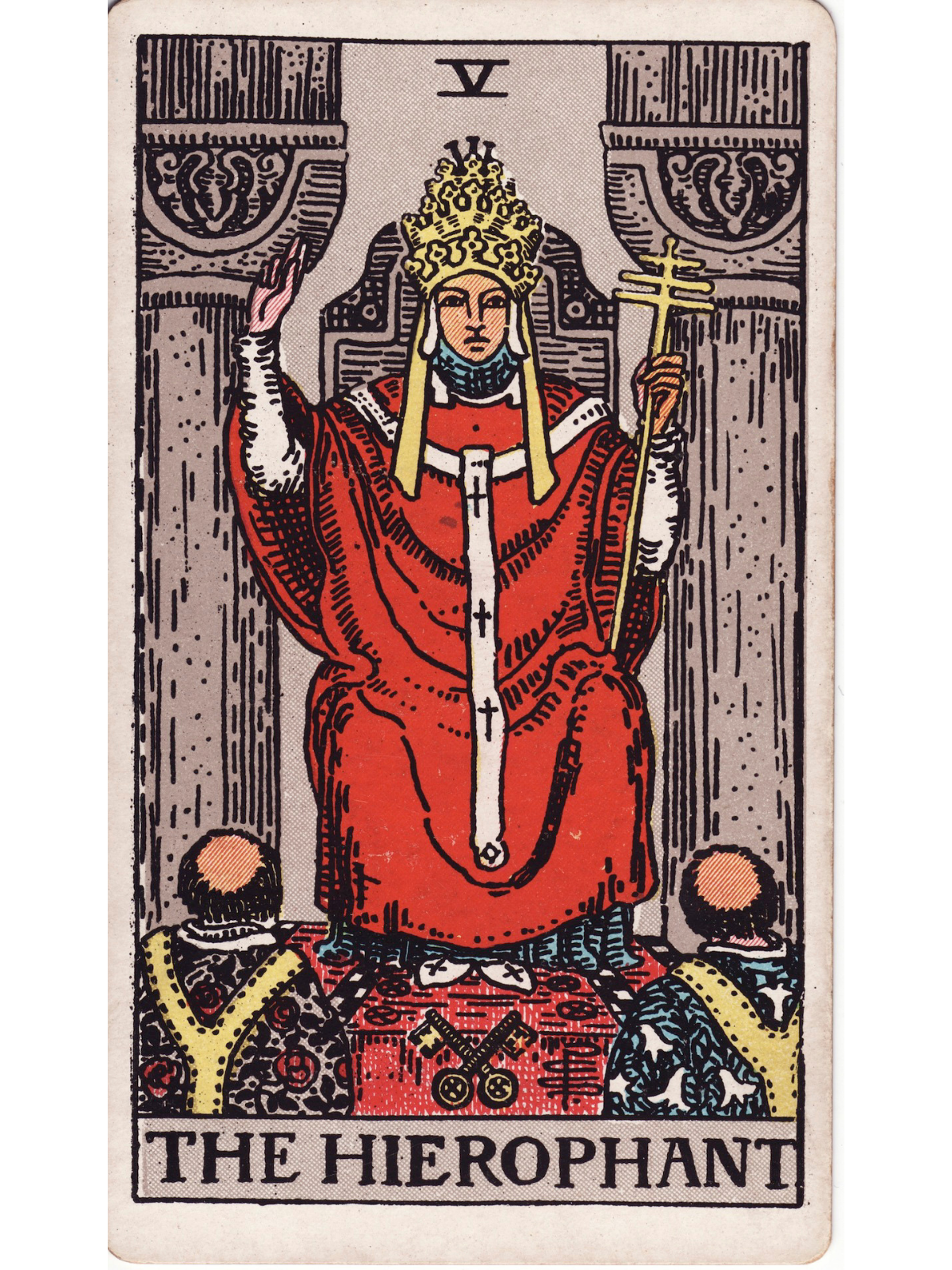
The Hierophant, card 5 of the Major Arcana. It represents tradition, spiritual teaching, and the wisdom we receive from those who came before us.
This post continues our journey through the Major Arcana, one card at a time. If you have not read the Major Arcana overview yet, that is a good place to start before diving into individual cards. So far, The Fool has stepped into the unknown, The Magician has discovered his tools, The High Priestess has taught us to listen within, and The Empress has shown us how to nurture growth. Most recently, The Emperor showed us how to build structure that lasts. Now we arrive at card five, The Hierophant, where the focus shifts from building our own world to learning from the wisdom of others. As always, everything here follows the Rider-Waite tarot.
The Card at a Glance
- Number: 5
- Keywords: Tradition, spiritual wisdom, teaching, mentorship, belief systems, community, ritual
- Element: Earth
- Reversed Keywords: Rebellion, rigid rules, questioning tradition, nonconformity, finding your own path
- Yes or No: Yes
What You See in the Card
The Hierophant sits on a throne between two gray stone pillars, inside what looks like a temple. He wears a heavy red robe over blue and white garments, and on his head rests a tall triple crown. His right hand is raised in a gesture of blessing, with two fingers pointing up and two folded down. In his left hand, he holds a golden staff topped with a triple cross. At his feet lie two crossed keys, one gold and one silver. Kneeling before him are two figures with shaved heads, one wearing a robe decorated with red roses and the other with white lilies.
After the solitary strength of The Emperor, The Hierophant brings people back into the picture. He is not alone on his throne. He is teaching, blessing, and guiding others. At first glance, it looks like a card about religion and rules. Look a little longer, and you start to see it is really a card about how wisdom is shared and passed from one generation to the next.
The Symbolism, Piece by Piece
The two pillars. Like The High Priestess, The Hierophant sits between two pillars. This connection is no accident. The High Priestess guards hidden, inner knowledge that each of us must discover for ourselves. The Hierophant shares outer, spoken knowledge that is taught openly within a community. She is the mystic. He is the teacher.
The raised hand. In Part 3 of my Tarot Symbolism Series on direction and body language, gestures reveal a great deal about a card’s meaning. The Hierophant’s raised hand is a sign of blessing. The two fingers pointing up and two folded down are often read as a reminder of the connection between heaven and earth. He acts as a bridge between the sacred and the everyday.
The triple crown. In Part 9 of my Tarot Symbolism Series on clothing, crowns and headwear show rank and responsibility. The Hierophant’s triple crown is often read as representing three worlds or levels of being: the physical, the emotional, and the spiritual. His authority reaches beyond the material world The Emperor rules.
The triple cross staff. The golden staff in his left hand carries three crossbars, echoing his three-tiered crown. It is a symbol of spiritual authority and of the different levels of understanding a student passes through on the path of learning.
The crossed keys. The gold and silver keys at his feet are among the most important symbols in the card. Gold is often linked to the conscious mind and the sun, while silver is linked to the subconscious and the moon. Together, they unlock the doors to knowledge. The Hierophant holds the keys, but he lays them at his feet, ready to pass them on to those who are prepared to learn.
The red robe. In the language of tarot colors, red speaks to passion, devotion, and life force. The Hierophant’s red robe shows his deep commitment to what he teaches. The blue and white beneath it bring in truth and purity, the quieter wisdom underneath his outward role.
The kneeling figures. The two figures before him are his students or followers. They show that The Hierophant’s role only makes sense in relationship to others. A teacher needs students, and a tradition needs people to carry it forward.
The roses and lilies. One student’s robe is covered in red roses, and the other’s in white lilies. In Part 6 of my Tarot Symbolism Series on plants and flowers, roses speak to passion and desire, while lilies speak to purity and spiritual thought. You may remember both flowers from The Magician’s garden. Here they appear on the students, showing that wisdom must balance the heart and the spirit.
Why Five Matters: The Numerology of The Hierophant
In Part 1 of my Tarot Symbolism Series on numerology, the number five carries the energy of change, challenge, freedom, and movement. After the solid stability of Four, Five shakes things up. In the Minor Arcana, the Fives often show conflict, loss, or struggle, the moments when our comfortable structures are tested.
At first, this might seem like an odd fit for a card so focused on tradition. But it actually makes perfect sense. Five is the number of the human experience, with five senses and five fingers on each hand. It is the moment when we start asking bigger questions about life, meaning, and belief. The Hierophant answers that restlessness by offering guidance, teachings, and a framework that helps us make sense of the change around us.
The Hierophant also reminds us that tradition itself was once something new. Every belief system, ritual, and teaching began with someone asking questions. Five is the number of searching, and The Hierophant is the teacher who helps us search with purpose.
The Hierophant Upright
When The Hierophant appears upright in a reading, it often points to learning, guidance, and connecting with something larger than yourself. This card may suggest finding a mentor, joining a group or community, studying a subject in depth, or turning to a spiritual practice or belief system for support.
I often tell my clients that The Hierophant is permission to learn from others. In a world that celebrates doing everything on your own, it can be humbling to admit that someone else may already have walked the road ahead of you. The Hierophant reminds you that there is no shame in asking for guidance. Some lessons are meant to be passed down.
He can also point to traditional choices and milestones, such as marriage, formal education, ceremonies, or following an established path. In some readings, he may represent stepping into the role of teacher or mentor yourself.
The Hierophant Reversed
Reversed, The Hierophant’s energy tends to show up in one of two ways, and your intuition along with the surrounding cards will help you sense which one applies. If you are still getting comfortable with reversals, my post on reading both sides of the card is a good companion to this section.
The first is breaking away from tradition. This is the seeker who no longer fits within the rules or beliefs they were raised with. It can point to questioning old teachings, choosing an unconventional path, or finding your own spiritual truth. This is not always negative. Sometimes the reversed Hierophant simply asks, “Do these beliefs still belong to you?”
The second is rigid rules and blind conformity. This is tradition that has hardened into control. It can point to following rules without questioning them, staying in a group or institution that no longer serves you, or a teacher or leader who misuses their authority. It is a reminder that wisdom should help you grow, not keep you small.
The Hierophant in Love, Career, and Finances
Love
For someone single, The Hierophant can point to meeting someone through a community, school, place of worship, or shared tradition. It may also suggest that you are looking for a committed, traditional relationship. In an existing relationship, he often signals commitment, marriage, or shared values that strengthen the bond. Reversed, he can point to a relationship that does not follow the expected path, differences in values, or pressure to meet others’ expectations.
Career
In career readings, The Hierophant favors established organizations, education, training, and working within a clear structure. He is especially positive for teaching, counseling, ministry, law, government, and any field built on tradition or expertise. He may also point to a mentor who helps you grow. Reversed, he may suggest feeling boxed in by workplace rules or a desire to break away and do things your own way.
Finances
Financially, The Hierophant favors conservative, time-tested approaches. Think steady savings, trusted institutions, and advice from experienced professionals. This is not the card for trendy or risky schemes. Reversed, he may suggest exploring a less traditional approach to money, or caution against following financial advice without asking questions.
Is The Hierophant a Yes or No Card?
Upright, The Hierophant is a yes, especially when your question involves following an established path, seeking guidance, or making a traditional commitment. His yes comes with a reminder to lean on the wisdom and support of others.
Reversed, The Hierophant leans toward no, or more accurately, not in the expected way. He suggests that the traditional route may not be the right one for you, and that it may be time to find your own answer.
When The Hierophant Shows Up in Your Reading
Because The Hierophant is a Major Arcana card, his appearance signals that learning, belief, and community are playing an important role in your situation. Pay attention to where he lands in a spread. In a past position, he may point to the values and teachings you were raised with. In a present position, guidance or a teacher may be available to you now. In a future or outcome position, commitment, learning, or a meaningful tradition is on its way.
Here are a few questions to sit with when The Hierophant comes up for you:
- Who are the teachers and mentors who have shaped my path?
- Which of my beliefs truly belong to me, and which have I simply inherited?
- Where could I benefit from guidance or community right now?
- Is there wisdom I am ready to pass on to someone else?
Final Thoughts
The Hierophant reminds us that none of us walks this path completely alone. After The Emperor builds the structure of our world, The Hierophant fills it with meaning, connecting us to the teachings, traditions, and communities that came before us. When he appears, he invites you to seek wisdom from those who have gone ahead, to honor the beliefs that truly serve you, and to remember that one day, you may be the one holding the keys.
Seeking Guidance on Your Path?
If you are looking for insight and want a fresh perspective on the questions you are carrying, I would love to read for you. You can order a tarot card reading by email anytime. Also, please don’t forget to like follow, share and subscribe to follow along as we explore the tarot card meanings of the Major Arcana, one card at a time.
Coming Up Next
Next time, we’ll meet The Lovers, card six, and explore what it means to choose with your heart and live in alignment with your values.
Has The Hierophant ever shown up when you were searching for guidance? I’d love to hear about it in the comments.
Kim’s Esoteric Tarot Journals
Tarot readings are intended for adults aged 18 and older and are provided for entertainment and personal reflection. Tarot should not replace professional medical, legal, mental health, or financial advice.
© 2026 Kim’s Esoteric Tarot Journals. All rights reserved.
 Kim's Esoteric Tarot Journals
