
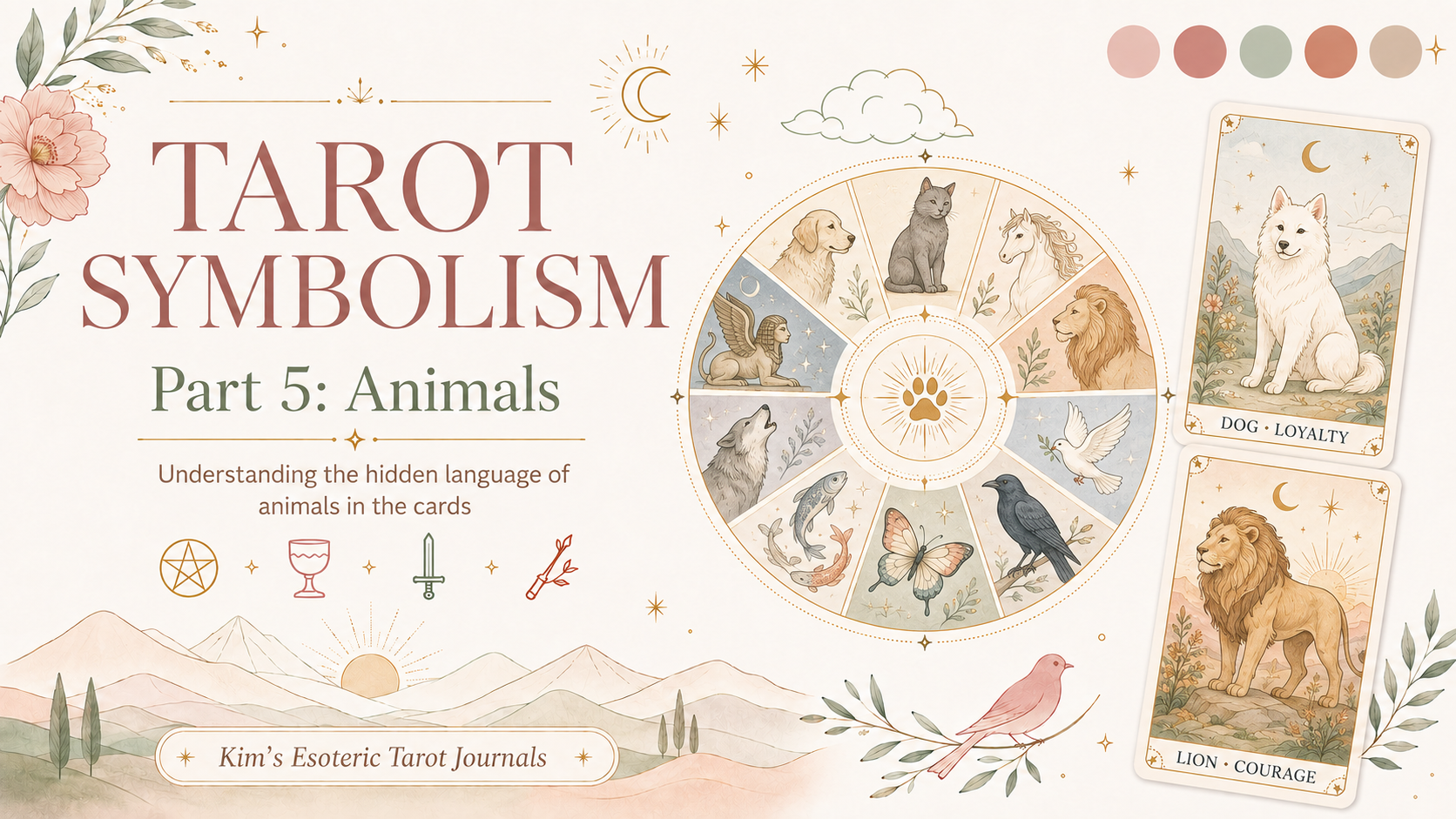
We have covered four layers of tarot symbolism so far: numerology, color, direction and body language, and clouds and weather. Each one adds a different kind of depth to a reading. Today we are turning our attention to the animals that appear throughout the Rider-Waite deck, because there are more of them than most people realize, and not one of them is there by accident.
Tarot Symbolism 105: What the Animals in Your Cards Are Saying
Animals in tarot carry both instinctive and symbolic meaning. They represent aspects of human nature that exist below the level of rational thought: drives, fears, loyalties, and appetites that do not show up cleanly in the human figures. When an animal appears in a card, it is almost always pointing to something primal, something that operates outside of what the conscious mind controls. Learning to read them gives you a direct line into the deeper layers of what a card is communicating.
Why Animals Matter in a Reading
The human figures in a tarot card represent the conscious actors in a situation: the choices being made, the roles being played, the intentions at work. Animals represent everything underneath that. A dog in the corner of a card is not just decorative. It is telling you something about loyalty, instinct, or the presence of a faithful companion, depending on the context. A serpent coiled around a figure is not just visual interest. It is carrying centuries of symbolic weight about wisdom, temptation, and transformation all at once.
I always tell my clients to notice animals the same way they notice people in a card. Ask what the animal is doing, not just what it is. A horse standing still carries different energy from a horse mid-gallop. A dog sitting calmly at its owner’s feet carries different energy from a dog barking at the edge of a cliff. The animal’s posture and position matter just as much as its species.
Animals Reference
Here is a quick reference for the animals most commonly found in Rider-Waite tarot cards and what each one generally brings to a reading.
| Animal | Core Energy | General Meaning |
| Dog | Loyalty | Faithfulness, protection, companionship, and instinctive trust |
| Cat | Independence | Self-sufficiency, mystery, and quiet observation |
| Horse | Power | Freedom, momentum, raw energy, and the drive to move forward |
| Bull / Ox | Endurance | Strength, stubbornness, fertility, and connection to the earth |
| Lion | Courage | Strength, nobility, passion, and the force of will over instinct |
| Eagle | Vision | Higher perspective, spiritual authority, and the ability to see clearly from above |
| Dove | Peace | Hope, purity, divine blessing, and the arrival of calm after difficulty |
| Raven / Crow | Omen | Hidden knowledge, the unconscious, transformation, and messages from unseen places |
| Ibis | Wisdom | Esoteric knowledge, communication with the divine, and the written record of truth |
| Butterfly | Transformation | Change, rebirth, the soul in transition, and beauty emerging from struggle |
| Serpent / Snake | Duality | Wisdom and temptation, healing and danger, cycles of death and renewal |
| Crayfish / Lobster | The unconscious | Primitive instinct, things rising from the depths, and fears surfacing from below |
| Fish | Abundance | Fertility, the unconscious mind, spiritual nourishment, and emotional depth |
| Ram / Goat | Determination | Ambition, headstrong energy, the push through obstacles, and Aries energy |
| Elephant | Memory | Ancient wisdom, patience, and the weight of accumulated experience |
| Wolf | Instinct | Raw nature, the untamed self, and the call of primal forces |
| Sphinx | Mystery | Ancient riddles, the threshold between the known and unknown, and timeless wisdom |
Quick Examples
The Fool has a small white dog at his heels. People debate whether the dog is warning him or celebrating with him, and that ambiguity is the point. The dog represents loyal instinct, the part of us that travels alongside our choices without judgment. It is not stopping The Fool. It is simply there, which says something about the nature of the leap he is taking.
Strength shows a woman gently closing the mouth of a lion with her bare hands. The lion is raw passion, anger, and physical force. The woman is not fighting it or fleeing from it. She is meeting it with calm and quiet confidence. The entire meaning of the card lives in that relationship between the human figure and the animal. Without the lion, there is no Strength card. It is the thing being worked with, not overcome.
The Moon card places a crayfish at the edge of a pool, beginning to climb out of the water. The crayfish represents the most primitive layer of the unconscious: the fears and instincts that live so deep we barely know they are there until they surface. Its emergence from the water is not comfortable. It is the moment when something that has been hidden below finally begins to come up, whether we are ready for it or not.
The Chariot shows two sphinxes, one black and one white, harnessed to the vehicle but pulling in opposite directions. They represent opposing forces that the charioteer has not fully tamed but has learned to direct. The card is not about domination. It is about holding competing energies in enough tension to move forward anyway. The sphinxes make that meaning specific in a way that no amount of text could.
How to Use This When You Read
When an animal appears in a card, slow down and give it a moment before moving on:
• What animal is it, and what does it carry symbolically?
• What is the animal doing? Is it still, moving, threatening, or at ease?
• How is it positioned relative to the human figures in the card?
• Is the same animal appearing in more than one card in your spread?
That last question is worth paying attention to. When the same animal shows up across multiple cards in a spread, it is usually pointing to a theme that runs through the entire reading. Multiple cards featuring dogs, for example, might be pointing to questions of loyalty or trust running through the situation as a whole. Let the animal symbolism work across the spread, not just within each individual card.
Animals are meant to add instinctive depth to a reading, not replace the card’s traditional meaning. Keep the question, the position in the spread, and your own intuition in the mix. The animals are speaking. It is worth listening to what they have to say.
Coming Up Next
Next we move from animals to the plant world and look at the flowers, vines, trees, and vegetation that appear throughout the Rider-Waite deck. Plants carry their own rich symbolic language, and some of the most quietly important symbolism in the deck lives in the details of what is growing in the background. After plants and flowers, the series continues through the four elements, celestial symbols, clothing, objects, landscapes and buildings, and repeated symbols.
Have you started noticing the animals in your cards? If so, what are your thoughts?
Tarot readings are intended for adults age 18 and older and are provided for entertainment and personal reflection. Tarot should not replace professional medical, legal, mental health, or financial advice.
© 2026 Kim’s Esoteric Tarot Journals. All rights reserved.
 Kim's Esoteric Tarot Journals
