
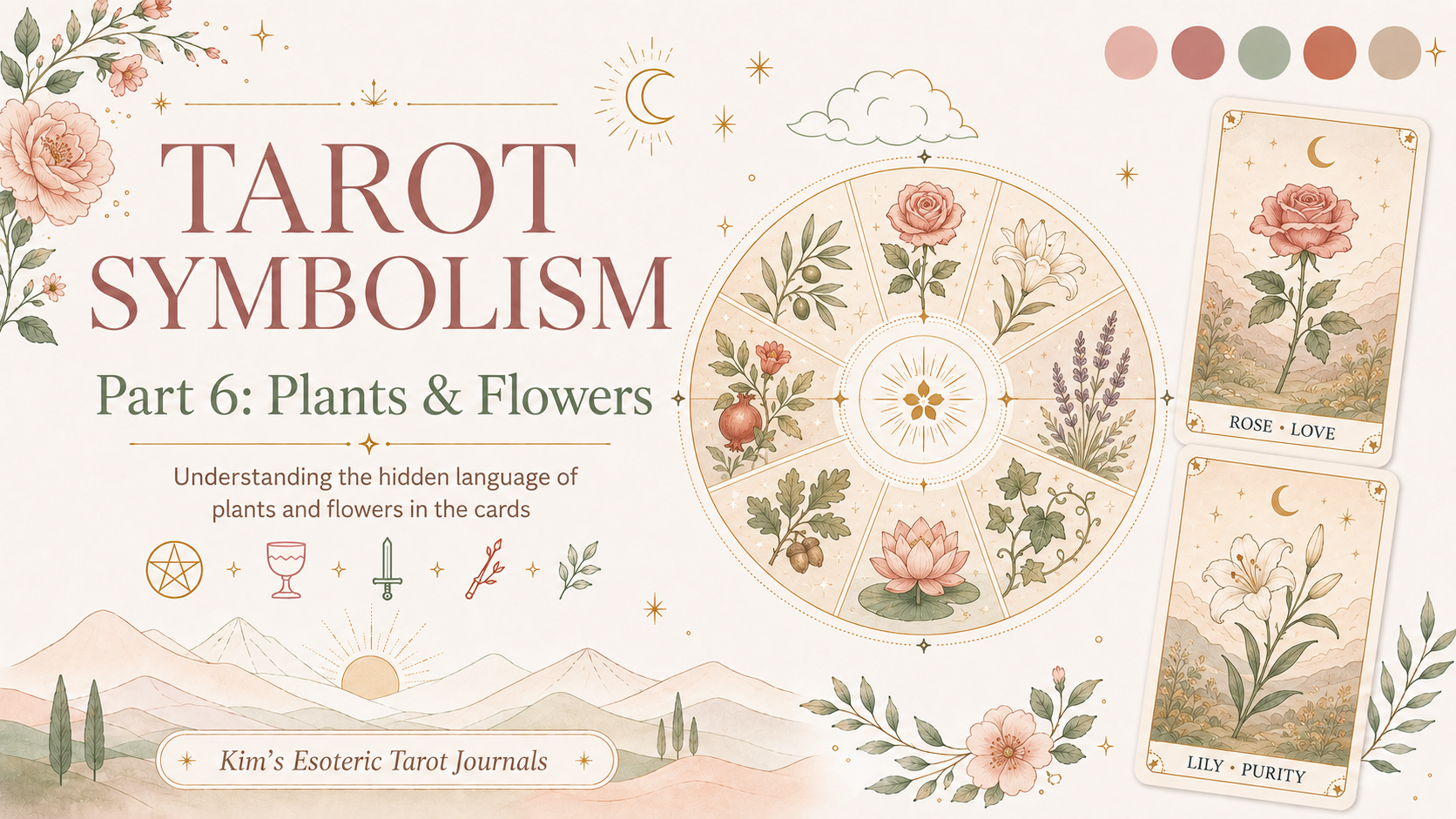
Tarot Symbolism 106: What Is Growing in Your Cards
Five layers of tarot symbolism are now in place: numerology, color, direction and body language, clouds and weather, and animals. Today we are looking at something quieter but just as deliberate: the plants and flowers woven into the backgrounds, borders, clothing, and foregrounds of the Rider-Waite deck. These details are easy to walk past, and that is exactly why they reward a closer look.
Plants and flowers have carried symbolic meaning across cultures and centuries. The artists behind the Rider-Waite deck drew on that tradition carefully. A white lily is not interchangeable with a red rose. A bare tree behind a figure says something completely different from a tree in full leaf. A garden scene and a wild open field have almost nothing in common symbolically, even if both show green growing things. The botanical details in these cards are a language, and once you learn a few of its words, you will find them everywhere.
What Plant Symbolism Adds to a Reading
Plants and flowers tend to work in the background of a card the way weather does: they set a condition rather than drive the action. A figure making a bold decision stands differently against a flourishing garden than against a barren landscape. The plant life surrounding the scene tells you something about the health, fertility, and underlying conditions of the situation, even when nothing in the foreground addresses it directly.
Color matters here too, and the two layers work together. A red rose brings both the symbolism of the rose and the charge of that particular red. A white lily carries purity in both its form and its color. When the plant symbolism and the color symbolism point in the same direction, the message is reinforced. When they point in different directions, the card is holding a tension worth noticing.
Plants and Flowers Reference
Here is a quick reference for the plants and flowers most commonly found in Rider-Waite tarot cards and what each one generally brings to a reading.
| Plant or Flower | Core Energy | General Meaning |
| Rose: red | Passion | Love, desire, beauty, and the presence of strong feeling |
| Rose: white | Purity | Innocence, spiritual love, and intention not yet acted upon |
| Lily | Purification | Clarity of thought, freedom from desire, and spiritual devotion |
| Sunflower | Vitality | Joy, loyalty to the light, abundance, and solar energy |
| Lotus | Enlightenment | Spiritual awakening, rising above difficulty, and divine potential |
| Wreath of leaves | Victory | Achievement, honor, completion, and a cycle successfully closed |
| Laurel | Triumph | Recognition, earned success, and mastery acknowledged by others |
| Wheat / Grain | Abundance | Material harvest, nourishment, the rewards of sustained effort |
| Grapevine | Fertility | Pleasure, abundance, celebration, and the richness of earthly life |
| Tree: full | Establishment | Maturity, deep roots, long-term growth, and things firmly in place |
| Tree: bare | Transition | Loss, dormancy, waiting, or a season that has not yet turned |
| Palm tree | Endurance | Resilience, victory through perseverance, and life sustained under pressure |
| Grass | Groundedness | Ordinary life, the natural world, and situations rooted in the everyday |
| Ivy / Vine | Attachment | Clinging, entanglement, growth that spreads, and bonds that hold fast |
| Garden | Cultivation | Tended growth, intentional effort, and the rewards of care over time |
| Wildflowers | Freedom | Natural beauty, spontaneous growth, and situations unfolding on their own terms |
| Pomegranate | Duality | Life and death, fertility and consequence, knowledge and its cost |
Quick Examples
The Magician stands before a garden of red roses and white lilies. That combination is deliberate. The red roses bring passion, desire, and active creative energy. The white lilies bring purity of intention and clarity of purpose. Together they frame the Magician as someone acting from a place of both genuine power and genuine alignment. The garden is not decorative. It is a character reference.
The High Priestess sits before a curtain decorated with pomegranates. The pomegranate carries one of the oldest symbolic weights in Western tradition: it is the fruit of knowledge with a price, the threshold between one world and another, the thing that once tasted changes everything. Its presence behind her is not subtle. She is the keeper of what lies beyond that threshold, and the pomegranates mark exactly where that boundary falls.
The Four of Pentacles shows a figure clutching his coins in a bare, cityscape setting with almost no plant life at all. That absence matters. Where other cards are lush with growth, this one is stripped of it. There is nothing fertile or generative in the scene. The message of hoarding and stagnation is reinforced by the total lack of anything growing anywhere near the figure.
The Empress is surrounded by some of the most abundant plant life in the entire deck: ripe wheat, a dense forest, a river, and a wreath of twelve stars above a cushion thick with vegetation. Every plant choice here points toward fertility, abundance, and the natural world in full productive force. She is not just sitting near these things. She is the reason they are there.
How to Use This When You Read
When plant life appears in a card, take a moment to read what it is doing before you move on:
• What type of plant or flower is it, and what does it carry symbolically?
• Is it in bloom, dormant, or absent entirely?
• How does the plant symbolism interact with the color of the plant?
• Is the vegetation lush and full, or sparse and struggling?
• Does the same plant appear across multiple cards in your spread?
The overall abundance or scarcity of plant life across a spread is worth noting on its own. A spread full of cards with rich, growing vegetation tends to suggest situations that have energy and life in them, things that can grow with the right attention. A spread where most cards are barren or stripped back tends to suggest depletion, waiting, or situations that have run their natural course.
Plant symbolism is meant to add texture and depth to a reading, not override the card’s traditional meaning. Keep the question, the position in the spread, and your intuition in the mix. The plants are quiet, but they are always telling you something.
Coming Up Next
Next we turn to the four elements: Fire, Water, Air, and Earth. The elements are the foundation beneath all four suits of the Minor Arcana, but they also run through the Major Arcana in ways that are easy to miss until you know what to look for. After the elements, the series continues through celestial symbols, clothing, objects, landscapes and buildings, and repeated symbols.
Have you started noticing the plant life in your cards? If so, what are your thoughts?
Tarot readings are intended for adults age 18 and older and are provided for entertainment and personal reflection. Tarot should not replace professional medical, legal, mental health, or financial advice.
© 2026 Kim’s Esoteric Tarot Journals. All rights reserved.
 Kim's Esoteric Tarot Journals
