
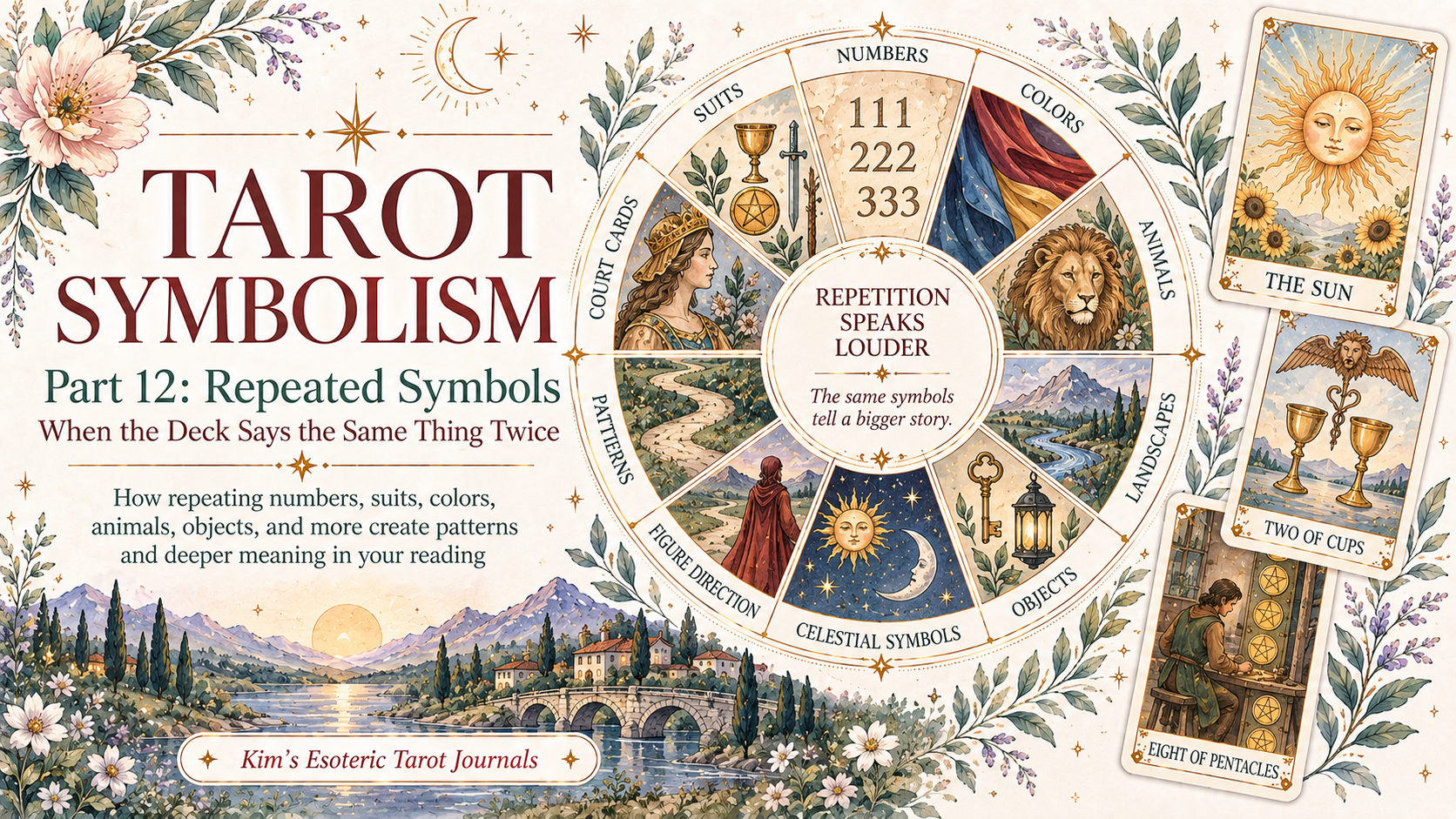
Tarot Symbolism 112: When the Deck Says the Same Thing Twice
This is the final post in the Tarot Symbolism Series. Over the past eleven posts we have worked through every major layer of symbolic language using the Rider-Waite deck: numerology, color, direction and body language, clouds and weather, animals, plants and flowers, the four elements, celestial symbols, clothing, objects, and landscapes and buildings. Today we are pulling all of that together to look at what happens when the same symbol appears more than once in a reading.
Repeated symbols are one of the most powerful things a spread can show you, and one of the least discussed. Most readers learn to read individual cards. Fewer learn to read the patterns running across the cards as a whole. That pattern-reading is where some of the deepest and most specific information in a reading lives. When the deck says the same thing twice, it is not an accident. It is an emphasis, and it is worth stopping to hear what is being repeated and why.
Why Repetition Matters
Every symbolic layer we have covered in this series operates at the level of the individual card. The color of a robe, the phase of the moon, the posture of a figure: these are details you read within a single card and then carry into your understanding of that card’s meaning. Repeated symbols work differently. They operate at the level of the spread as a whole, and they reveal patterns that no single card could show you on its own.
Think of it this way. If one card in a spread shows a figure facing left, that is a detail. If three cards in a spread show figures facing left, that is a theme. The spread is not just showing you three separate situations. It is showing you a reading dominated by backward-looking energy, by reflection, by the pull of the past. That is a very different conversation than the one you would have reading each card individually, and you can only see it by looking at the spread as a whole.
Repetition in tarot functions the same way it does in any other form of communication. When something is said once, you note it. When it is said again, you pay closer attention. When it appears a third time, you stop what you are doing and listen. The deck is always communicating. Repeated symbols are the moments when it raises its voice.
What to Look For
Before diving into the reference table, here is a practical starting point. After you lay out a spread, before you read any individual card, scan the spread as a whole and ask yourself these four questions:
• Is one suit appearing more than the others?
• Is one number appearing more than once?
• Is one color, animal, landscape feature, or object showing up across multiple cards?
• Are the figures in the spread generally facing the same direction, or are they scattered?
You will not always find a strong repeated pattern, and that is fine. A spread with balanced variety across suits, numbers, and imagery is telling you that the situation has many different elements in play without a single dominant force. But when a pattern does emerge, it is almost always the most important thing the reading has to say, and it deserves to be named before you read any individual card.
Repeated Symbols Reference
Here is a quick reference for the most common repeating patterns and what they generally signal in a reading.
| Repeated Pattern | What It Signals | How to Read It |
| Same suit appearing multiple times | Elemental dominance | One area of life is driving the reading: fire, water, air, or earth energy is running the show |
| Same number appearing multiple times | Numerological theme | The energy of that number is the thread connecting the situation across all of its different areas |
| Same color across multiple cards | Tonal consistency | A single emotional or spiritual quality is present throughout, coloring every part of the situation |
| Same animal across multiple cards | Instinctive thread | A particular quality of instinct, loyalty, power, or wildness is running through the reading as a whole |
| Same landscape feature repeated | Situational pattern | The conditions of the situation are consistent across time or across different areas of the question |
| Same celestial body repeated | Cosmic emphasis | A specific kind of spiritual or cyclical influence is present throughout the entire reading |
| Same object appearing multiple times | Recurring tool | Something specific is at the center of the situation in every area it touches |
| Court cards from same suit | Personality pattern | A particular type of energy or person is showing up in multiple roles across the reading |
| Multiple Major Arcana cards | Elevated stakes | The situation involves forces larger than the immediate moment, things that carry real weight and consequence |
| No Major Arcana present | Personal agency | The situation is in the hands of the people involved; external fate is not the dominant factor here |
| Figures facing each other | Dialogue or tension | Two forces, people, or parts of the situation are in direct relationship, for better or worse |
| Figures all facing away | Avoidance or dispersal | Energy is moving outward or away; connection between the elements of the situation is weak or broken |
| Repeating elemental contrast | Unresolved tension | Two opposing energies are present throughout the reading without resolution, a situation still finding its balance |
Quick Examples
A client once brought me a five-card spread in which four of the five cards were Cups. Before I said a single word about any individual card, I told her that this reading was primarily about her emotional life, her relationships, and her inner world, and that whatever question she had asked was going to find its answer there rather than in practical action or mental clarity. She had asked about a career decision. The Cups did not change the question, but they told her clearly that the real heart of the decision was an emotional one, not a strategic one. That was the most useful thing the spread had to say, and it came entirely from the repeated suit.
A three-card spread showing the Two of Swords, the Four of Swords, and the Eight of Swords has a repeated number pattern worth noting: two, four, and eight are all even numbers and all carry the energy of stillness, waiting, and held or blocked energy. Even before you read the individual cards, the numerological pattern is pointing toward a situation that is paused, suspended, or deliberately immobilized. The specific details of each card then tell you how and why.
When the same animal appears across multiple cards in a spread, I always pause and name it for my client. If dogs are showing up in two or three cards, something about loyalty, faithfulness, or instinctive trust is a thread running through the entire situation. If serpents appear more than once, questions of wisdom and temptation or cycles of transformation are woven through the reading in a way that a single serpent in a single card would not convey. The animal is not just a detail in those individual cards. It is a character in the reading as a whole.
Multiple Major Arcana cards in a single spread always get my attention. When three or more Majors appear together, the reading is no longer primarily about day-to-day circumstances. Something of real weight is in motion: an archetypal force, a significant life transition, or a situation that carries consequences beyond the immediate moment. I tell my clients to sit with those readings longer than they might otherwise. The Majors are asking for it.
How to Put the Whole Series Together
Now that all twelve layers are in place, here is how I recommend building them into your reading practice. You do not need to consciously check all twelve layers on every card. That would make reading feel like an exam rather than a conversation. Instead, work with them as a background awareness that sharpens over time.
• Start with the spread as a whole: suit distribution, number patterns, and dominant colors before you read any single card.
• Then read each card starting with its biggest impression: what does the overall image communicate before you analyze any detail?
• Layer in the specific symbolism that stands out: a striking posture, an unexpected animal, a landscape that feels significant.
• Close by asking what the spread is saying as a whole: what repeated patterns emerged, and what do they mean for the question at hand?
The twelve layers of symbolism in this series are not a checklist. They are a vocabulary. The more fluently you speak them, the less you will need to think about them consciously, and the more naturally the deeper meaning of each card and each spread will surface on its own. That is what it means to read tarot rather than translate it.
I started this series by saying that every tarot card is more than its name and traditional meaning. I hope by now you can see exactly what I meant. Each card is a complete symbolic world, and the more of that world you can read, the richer and more specific your readings become. The symbolism is always there. It has just been waiting for you to look. Always use your intuition when doing so.
What Comes Next
The Tarot Symbolism Series is now complete. From here, the blog moves into individual card studies, beginning with the Major Arcana one card at a time. Each post will put everything from this series to work: reading the number, the colors, the figures’ posture and clothing, the landscape, the objects, the animals, and the celestial details of a single card in depth. If you have been following along through all twelve parts of this series, those individual card posts are where the real payoff begins.
Thank you for working through this series with me. What has been the most useful layer of symbolism for your own readings? I would love to hear your thoughts.
Tarot readings are intended for adults age 18 and older and are provided for entertainment and personal reflection. Tarot should not replace professional medical, legal, mental health, or financial advice.
© 2026 Kim’s Esoteric Tarot Journals. All rights reserved.

 Kim's Esoteric Tarot Journals
