
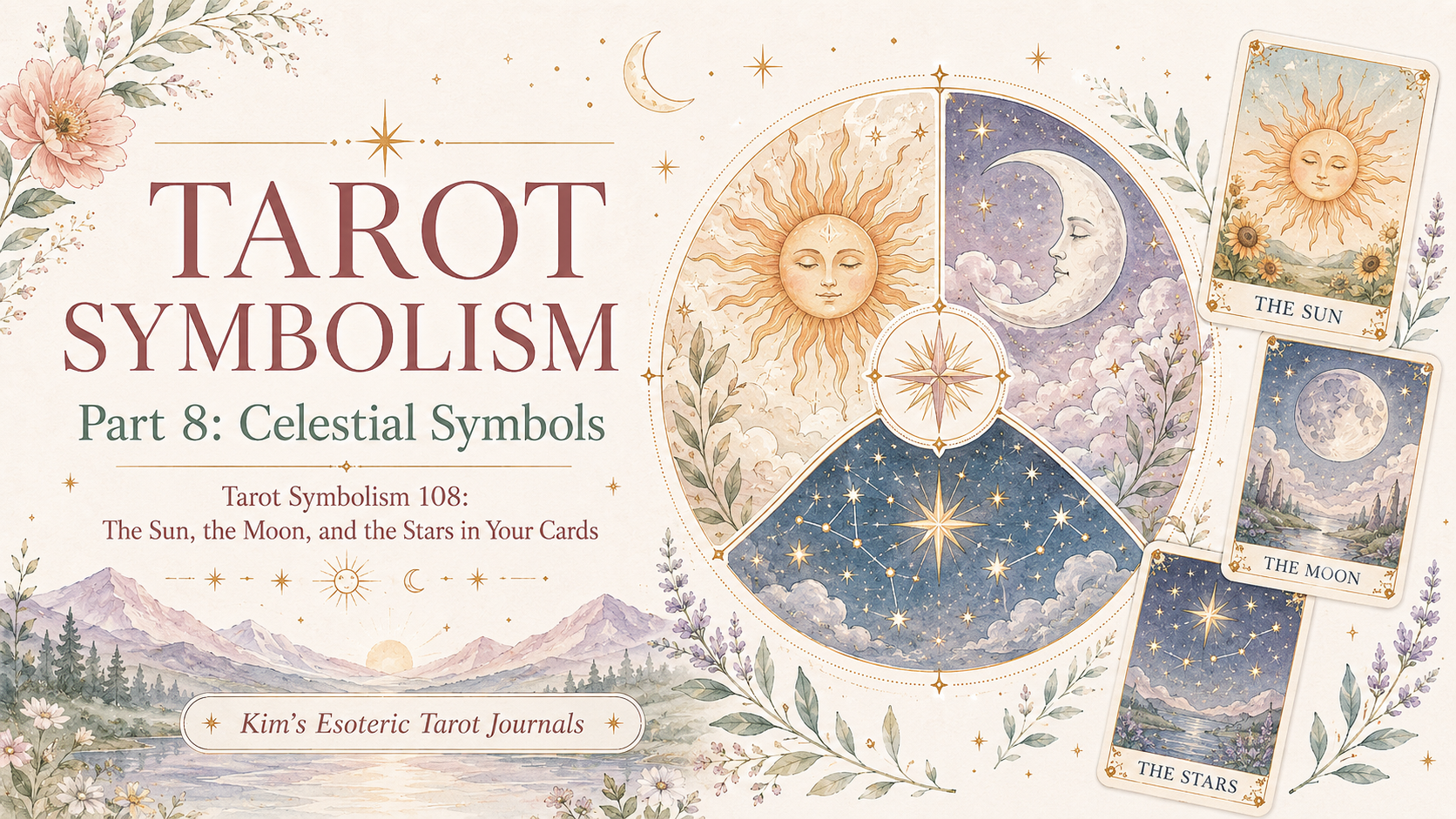
Tarot Symbolism 108: The Sun, the Moon, and the Stars in Your Cards
Seven layers of tarot symbolism are now in place. Today we are looking at celestial symbols: the sun, the moon, the stars, planetary glyphs, halos, and the other heavenly details that appear throughout the Rider-Waite deck. In Part 4 we covered the sky as atmosphere, focusing on clouds and weather and what they say about the emotional climate of a card. Celestial symbols are something different. They are not atmosphere. They are fixed points of meaning, and they carry a specific kind of authority that weather does not.
The sky in a card can change. A storm can clear. Clouds can part. But the sun, the moon, and the stars in tarot are not passing conditions. They are presences, and each one is placed exactly where it is for a reason. When a card carries celestial imagery, it is usually signaling something that operates beyond the immediate moment of the situation, something connected to larger cycles, divine influence, or a truth that exists independent of what the human figures in the card are doing.
Celestial Symbols Versus Atmospheric Conditions
It is worth being clear about the distinction between what we covered in Part 4 and what we are covering today, because the sky holds both and they work differently. Atmospheric conditions like storm clouds, clear skies, and rough water tell you about the emotional and situational climate surrounding the action in a card. They are contextual. They shift depending on where you are in a reading.
Celestial symbols carry a different weight. The sun in The Sun card is not commenting on the weather. It is the central presence of the card, a source of life and clarity that does not waver. The moon in The Moon card is not a passing cloud. It is an unreliable light casting shadows over an uncertain path. The stars in The Star card are not decoration. They are a promise. Celestial symbols tend to point toward something absolute, something that is true regardless of the moment the reading is happening in.
Celestial Symbols Reference
Here is a quick reference for the celestial symbols most commonly found in Rider-Waite tarot cards and what each one generally brings to a reading.
| Symbol | Core Energy | General Meaning |
| The Sun | Vitality | Consciousness, life force, clarity, success, and energy that sustains |
| The Moon: full | Completion | Heightened intuition, emotional fullness, and things coming to a peak |
| The Moon: crescent | Becoming | Growth, new beginnings, and potential still in the process of forming |
| The Moon: waning | Release | Letting go, endings approaching, and energy beginning to withdraw |
| Stars: single | Guidance | A fixed point of hope, divine direction, or a sign worth following |
| Stars: many | Possibility | Abundance of hope, spiritual blessing, and the vast scope of what is available |
| Eight-pointed star | Renewal | Balance restored, cycles completing and beginning again, divine harmony |
| Twelve stars | Wholeness | Completion of a full cycle, all signs represented, nothing left out |
| Lightning bolt | Revelation | Sudden illumination, a truth striking fast, or a system breaking open |
| Halo or aureole | Divinity | Sacred energy, spiritual authority, and connection to a higher source |
| Crown of stars | Elevation | Spiritual mastery, divine favor, and authority that comes from above |
| Planetary symbols | Cosmic law | The influence of a specific planet and the qualities it governs in astrology |
| Rainbow | Covenant | Promise, hope after difficulty, and the bridge between the human and divine |
| Sun behind clouds | Obscured truth | Clarity not yet available, something true but not yet fully visible |
Quick Examples
The Star card is one of the most celestially rich cards in the entire deck. A large eight-pointed star sits at the center of the sky, surrounded by seven smaller stars. The large star represents renewed balance and divine harmony. The seven surrounding stars have been interpreted as the seven classical planets, the seven chakras, and the seven days of the week, depending on the tradition you are reading from. What they share across all of those interpretations is the same meaning: abundance of blessing, nothing withheld, hope restored in full. The star count in this card is not arbitrary. Twelve would mean something different. Seven surrounding one means something specific.
The High Priestess sits with a crescent moon at her feet and a crown that incorporates lunar phases. The crescent at her feet is a moon in its becoming stage, still growing toward fullness. Her crown shows the full cycle: waxing, full, and waning. She does not just represent intuition. She represents the full arc of what knowing something feels like, from the first sense that something is true, through the moment of complete clarity, and into the wisdom that comes after. The lunar imagery makes that arc visible in a way the figure alone could not.
The World card shows a dancing figure encircled by a wreath and surrounded in the four corners by four fixed signs: the bull, the lion, the eagle, and the angel, which correspond to Taurus, Leo, Scorpio, and Aquarius. These are the four fixed signs of the zodiac and the same figures that appear on the Wheel of Fortune. Their presence in both cards is not coincidence. In the Wheel they mark the turning of cycles. In the World they mark the completion of one. The cosmic framework is the same. The position within it has changed.
The Tower has a lightning bolt striking its crown. This is not weather. It is revelation, sudden and violent illumination that cannot be redirected or softened. The lightning bolt in tarot always carries that quality of a truth arriving faster than preparation allows. It does not ask permission. It does not build gradually. It arrives all at once, and whatever was standing before it arrived has to reckon with what the light reveals.
How to Use This When You Read
When a celestial symbol appears in a card, pause and consider what it is doing in the scene:
• Is the sun, moon, or a star the central focus of the card, or is it a detail in the background?
• What phase is the moon in, and what does that phase suggest about where the situation is in its cycle?
• How many stars are present, and does the number connect to a numerological meaning?
• Is there a halo, crown of stars, or planetary symbol present that signals divine authority or cosmic influence?
• Does the celestial imagery feel like a blessing, a warning, or a neutral marker of where things stand?
Celestial symbols almost always point toward the larger context surrounding a situation rather than the immediate action. When they appear prominently in a reading, they are often asking you to step back from the day-to-day details and consider what is actually at work beneath the surface. A card heavy with celestial imagery is usually one where the situation has larger implications than it might appear to on first look.
Celestial symbols are meant to add spiritual depth and cosmic context to a reading, not override the card’s traditional meaning. Keep the question, the position in the spread, and your intuition in the mix. The stars are always there. It just takes a moment to look up and read them.
Coming Up Next
Next we come back down to earth and look at clothing: what the robes, armor, crowns, and garments worn by the figures in the Rider-Waite deck reveal about who they are and what they represent. After clothing, the series wraps up with objects, landscapes and buildings, and repeated symbols.
Have you started noticing the celestial details in your cards? If so, what are your thoughts?
Tarot readings are intended for adults age 18 and older and are provided for entertainment and personal reflection. Tarot should not replace professional medical, legal, mental health, or financial advice.
© 2026 Kim’s Esoteric Tarot Journals. All rights reserved.
 Kim's Esoteric Tarot Journals
