
Tag Archives: tarot-cards

Tarot Symbolism Series: Part 1 – Numerology

**Alt text:**
Tarot Symbolism 101 blog graphic featuring two numbered tarot cards, a crescent moon, crystals, flowers, and the title “Part 1: Numerology” for Kim’s Esoteric Tarot Journals.
Explore the hidden language of tarot through numerology and discover how numbers help reveal the deeper story within the cards.

Tarot Symbolism 101: Understanding Numerology in the Cards

Before we get into individual meanings for each tarot card in future blogs, I want to spend a little time on tarot symbolism.

This builds on the foundation from the Major Arcana and Minor Arcana overviews, so if you haven’t read those yet, they’re a great place to start.

Every tarot card is more than its name and traditional meaning. Each image is built from layers of symbolism, including colors, numbers, animals, clothing, weather, objects, and landscapes. See the full list below. Once you learn to read these details, you stop memorizing definitions and start seeing the story each card is telling.

This post kicks off a series on tarot symbolism. Below is a quick look at the types of symbols we will cover, followed by a deep dive into the first one: numerology.

Types of Tarot Symbolism

  • Numerology – the meaning of numbers and numerical cycles
  • Colors – how color influences the mood of a card
  • Direction and body language – what a figure’s gaze or posture reveals
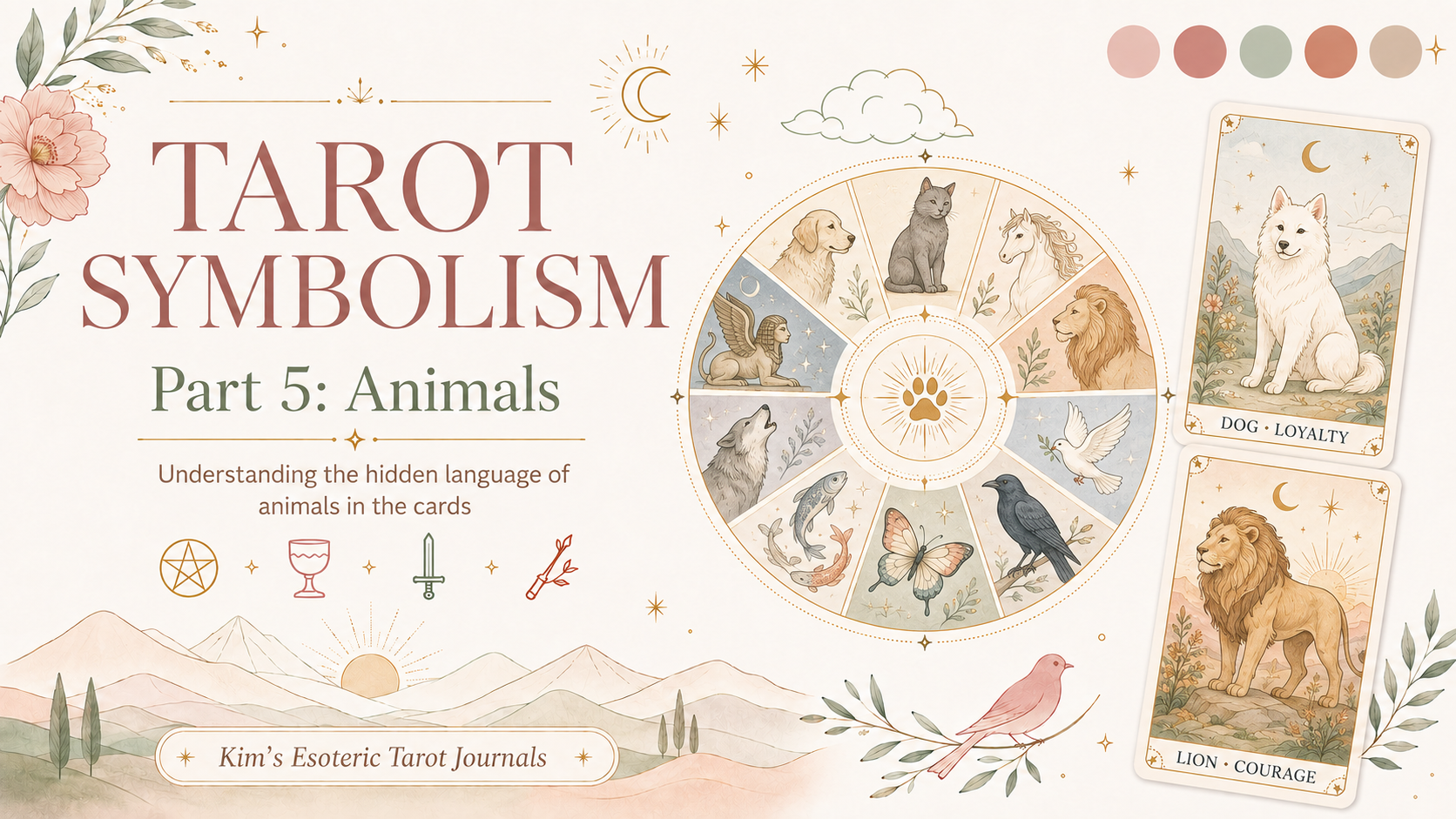
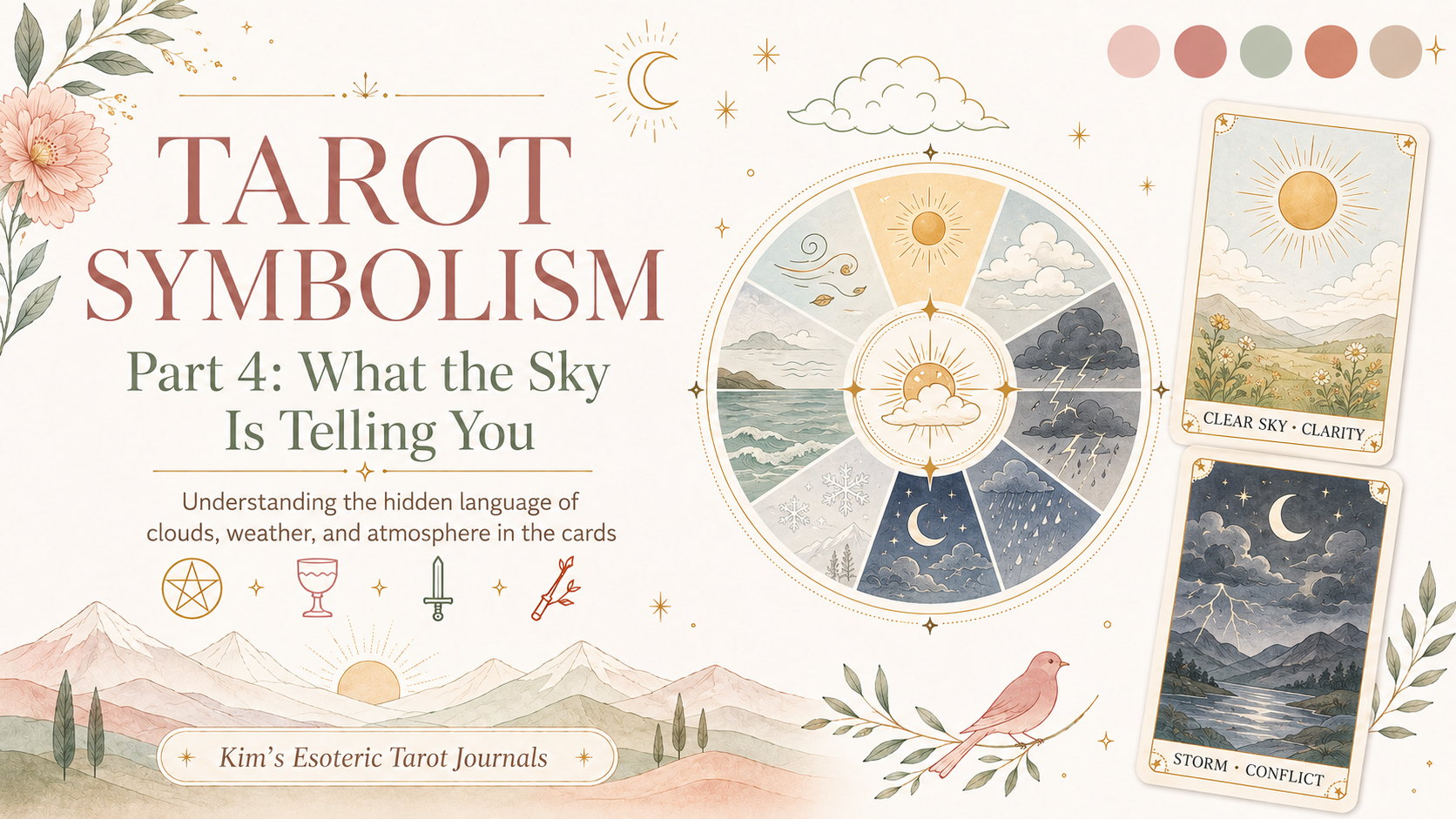
  • Clouds and weather – the atmosphere surrounding a situation
  • Animals – instinctive and spiritual meanings
  • Plants and flowers – symbolism found in nature
  • The four elements – Fire, Water, Air, and Earth
  • Celestial symbols – the Sun, Moon, stars, and planets
  • Clothing – what robes, crowns, and armor reveal
  • Objects – keys, swords, cups, and other meaningful items
  • Landscapes and buildings – mountains, towers, bridges, and paths
  • Repeated symbols – patterns that strengthen a message

First Up: Numerology

Numerology looks at how numbers shape the meaning of a card. The number tells you where a situation sits in its natural cycle: just beginning, developing, stable, being challenged, or wrapping up. The suit tells you which area of life that energy is showing up in.

  • Wands – passion, creativity, and action
  • Cups – emotions, relationships, and intuition
  • Swords – thoughts, communication, and conflict
  • Pentacles – money, work, and physical security

Numerology Chart

NumberCore EnergyGeneral Meaning
0PotentialFreedom, possibility, and stepping into the unknown
1BeginningInitiative, opportunity, and new starts
2BalancePartnership, choices, and patience
3GrowthCreativity, communication, and expansion
4StabilityStructure, security, and strong foundations
5ChangeConflict, disruption, and necessary adjustment
6HarmonyHealing, support, and restored balance
7AssessmentReflection, strategy, and discernment
8PowerMomentum, discipline, and mastery
9CulminationWisdom, resilience, and near completion
10CompletionFulfillment, closure, and renewal

Quick Examples

The Two of Cups and the Two of Swords both carry the balancing energy of Two, but the suit changes the story. The Two of Cups often points to connection, partnership, or mutual attraction, while the Two of Swords often points to a difficult choice or feeling stuck between two options. Same number, same underlying theme of balance, but a very different experience depending on the suit.

The same pattern shows up with the Five of Cups and the Five of Pentacles. Both carry the disruptive energy of Five, but they show up in different areas of life. The Five of Cups often points to grief or disappointment, while the Five of Pentacles often points to money, job loss, or feeling left out. The number sets the theme, and the suit shows you where that theme is playing out.

How to Use This When You Read

Next time a numbered card shows up in a reading, ask a few quick questions:

  • What does this number generally represent?
  • What area of life does the suit point to?
  • Is this number repeated elsewhere in the spread?

Numerology is meant to add depth to a reading, not replace the card’s traditional meaning. Keep the question, the position in the spread, and your own intuition in the mix too.

Coming Up Next

Numerology is just one layer of tarot’s symbolic language. In the next blog, we will work through colors before continuing on to the rest of the series: direction and body language, clouds and weather, animals, plants and flowers, the four elements, celestial symbols, clothing, objects, landscapes and buildings, and repeated symbols.

Have you used tarot symbolism in your readings? If so, what are your thoughts?

Tarot readings are intended for adults age 18 and older and are provided for entertainment and personal reflection. Tarot should not replace professional medical, legal, mental health, or financial advice.© 2026 Kim’s Esoteric Tarot Journals. All rights reserved.
How an Email Tarot Reading Works at Kim’s Esoteric Tarot Journals

Bright tarot reading workspace with pastel cards, an open journal, crystals, flowers, tea, and a laptop displaying an email tarot reading.
A peaceful look at how personalized email tarot readings are thoughtfully prepared and delivered by Kim’s Esoteric Tarot Journals.

Why Choose an E-Mail Tarot Card Reading?

If you have never received a tarot reading by email, you may wonder how the process works and whether a written reading can feel as personal as an in-person session.

The answer is yes.

An email tarot reading allows me to carefully study your question, examine the relationships between the cards, and provide you with a detailed written interpretation that you can read privately and return to whenever you need it.

Here is what you can expect when ordering a reading from Kim’s Esoteric Tarot Journals.

Choosing the Right Tarot Reading

The first step is selecting the reading that best fits your situation.

Some clients need guidance about one specific concern. Others are dealing with a more complicated situation involving relationships, career decisions, personal growth, or several connected questions.

Each reading offered by Kim’s Esoteric Tarot Journals includes a specific number of questions or cards. The description of each reading explains what it is designed to address.

Choose the reading that gives your situation enough room to be explored properly. Trying to squeeze a complicated issue into a single-question reading may limit the amount of detail the cards can provide.

Preparing Your Question

A well-written question helps create a more focused and meaningful reading.

Open-ended questions usually provide more insight than questions that can only be answered with yes or no.

For example, instead of asking:

“Will my relationship work?”

You might ask:

“What do I need to understand about the current direction of my relationship?”

Rather than asking:

“Will I get a new job?”

You might ask:

“What should I know about my current career opportunities and the steps I need to take next?”

You do not need to write a long explanation, but relevant background information can help me understand the situation surrounding your question.

Submitting Your Reading Request

After choosing your reading and completing your payment, email your reading information to:

ketjournals@gmail.com

Please include:

  • Your first name
  • Your age
  • Your gender
  • Your date of birth
  • The email address where you want the reading delivered
  • The reading you selected
  • Your question or area of concern
  • Any important background information

When submitting your PayPal payment, include “Consultation” and the number of the reading you selected in the payment note whenever possible.

Your personal information is used only to help me focus on you and the situation being explored. It is not shared or published.

How the Tarot Cards Are Selected

Before selecting the cards, I take time to review your question and focus on the energy surrounding your situation.

The cards are then shuffled and selected specifically for your reading.

I do not simply look up isolated card meanings and send you a list of definitions. Tarot cards must be interpreted in relation to one another.

The position of each card, the surrounding cards, repeated suits, Major Arcana cards, court cards, reversals, and the overall energy of the spread can all affect the message.

My role is to bring those pieces together and explain the story the cards are presenting.

What Your Reading May Reveal

A tarot reading may help identify:

  • Patterns influencing your current situation
  • Feelings or motivations that have not been openly expressed
  • Obstacles that may be slowing your progress
  • Strengths or opportunities you may be overlooking
  • Possible consequences of continuing along your current path
  • Areas where you may need greater clarity or stronger boundaries
  • Steps you can consider as you move forward

Tarot does not remove your free will.

The cards may reveal the direction in which a situation appears to be moving, but your choices—and the choices of other people involved—can change that direction.

Receiving Your Written Reading

Your completed reading will be delivered by email within approximately 24 to 72 hours.

Your reading will include the cards selected, their positions when applicable, and my interpretation of how they relate to your question.

Because the reading is written, you can take your time absorbing the message. You may notice something during your second or third reading that did not stand out the first time.

Many people also save their readings in a journal so they can return to them later and compare the guidance with what eventually unfolded.

Honest Guidance, Not False Promises

I will always approach your reading with compassion, but I will not change the meaning of the cards simply to provide the answer you hoped to receive.

Sometimes a reading confirms what you already feel. At other times, it may challenge your assumptions or point toward something you have been avoiding.

A difficult card does not automatically predict disaster. It may be highlighting a warning, an unhealthy pattern, a necessary ending, or an area that requires your attention.

The purpose is not to frighten you. The purpose is to help you see the situation more clearly.

Privacy and Confidentiality

Your reading is private.

Your question, personal information, and reading results will not be shared publicly or discussed with anyone else.

I understand that clients often seek tarot guidance during emotionally sensitive periods. Every reading is handled respectfully and confidentially.

What My Tarot Readings Do Not Cover

Tarot readings from Kim’s Esoteric Tarot Journals are available only to adults who are at least 18 years old.

I do not provide readings that diagnose medical or mental-health conditions, replace legal advice, make financial-investment decisions, determine pregnancy, or predict death.

I am not a physician, therapist, attorney, or financial adviser.

Tarot readings are provided for entertainment, spiritual reflection, and personal insight. Important medical, legal, psychological, and financial matters should be discussed with an appropriately qualified professional.

The Purpose of a Tarot Reading

A tarot reading should not control your life or make every decision for you.

Its greatest value is helping you pause, look beneath the surface, and examine your situation from a different perspective.

The cards may confirm what your intuition has already been telling you. They may reveal a pattern you have not recognized or help you identify questions that still need to be answered.

You remain responsible for your decisions.

Tarot simply gives you another tool for approaching those decisions with greater awareness, honesty, and clarity.

Blessings,

Kim
Kim’s Esoteric Tarot Journals

The Minor Arcana: The Mundane, Day-toDay Events of Everyday Life

Bright flat-lay image for a tarot blog about the Minor Arcana, featuring four illustrated tarot suit cards for Wands, Cups, Swords, and Pentacles on a light desktop with flowers, candle, crystals, notebook, and soft purple accents.
The Minor Arcana reminds us that tarot is not only about major turning points — it is also about the ordinary choices, emotions, conversations, and practical moments that shape everyday life.

Last time, we slowed down inside the Major Arcana and walked the Fool’s Journey from card 0 to card 21. If you missed it, the short version is this: those twenty-two cards describe the big stuff, the turning points and defining moments that mark a real before and after in someone’s life. Today we’re turning to the other half of the deck, the fifty-six cards that make up the Minor Arcana, the ones I tell my clients to think of as the texture of daily life rather than its headlines.

What Makes the Minor Arcana Different

If the Major Arcana is the chapter titles of your story, the Minor Arcana is everything written on the pages in between. These cards don’t carry the weight of fate or transformation the way The Tower or Death do. Instead, they speak to the week you’re having: a conversation that didn’t go the way you hoped, a financial decision you’re sitting with, the mood that’s been following you around since Tuesday. When a Minor Arcana card turns up in a reading, I don’t ask my clients to sit up straighter the way I do with the Majors. I ask them to think about what’s actually happening in their life right now, because that’s almost always where the answer is hiding.

The fifty-six Minor Arcana cards are organized into four suits: Wands, Cups, Swords, and Pentacles. Each suit is tied to one of the four classical elements, and that elemental association tells you almost everything you need to know about what a suit is “about” before you ever look at a single card from it.

The Four Suits

Here are the four suits and the element each one carries. I won’t list all fifty-six cards individually today; that’s what the suit-by-suit posts coming up will be for, but understanding these four building blocks is really the heart of reading the Minor Arcana well.

Wands: Fire. The suit of passion, ambition, and creative spark. Wands cards show up around action, energy, and the early, electric stage of any new idea or undertaking.

Cups: Water. The suit of feeling. Cups cards live in the emotional and relational parts of life: love, intuition, connection, and the inner world we don’t always say out loud.

Swords: Air. The suit of the mind. Swords cards deal in thought, truth, conflict, and communication, the sharp-edged clarity that comes from facing something head-on.

Pentacles: Earth. The suit of the material world. Pentacles cards govern money, work, health, and the tangible, grounded results of our day-to-day effort.

Each of these four suits is built the same way: every suit runs from the Ace through the King, fourteen cards in total, which is where you get fifty-six cards across all four suits. Once you understand how one suit is built, you understand the architecture of the entire Minor Arcana, which is really what I want to leave you with today.

Inside Each Suit: Ace Through King

Within every suit, the numbered cards run Ace through Ten, and they tell one continuous story, the same way the Major Arcana does, just on a smaller, more personal scale. The Ace is the spark: a new opportunity arriving in whatever form that suit takes, pure potential and nothing built yet. From there, the Two through Ten trace that spark through choices, partnerships, setbacks, and effort, until the Ten arrives as a kind of small completion, the natural endpoint of whatever that suit set out to do.

After the Ten, each suit shifts into four court cards: the Page, the Knight, the Queen, and the King. These aren’t part of that numbered arc; they’re something different entirely, closer to people than to events. The court cards represent personalities, roles, or even actual people who might be relevant to your reading, each one carrying the qualities of their suit but expressed through a particular kind of presence and maturity. A King of Wands and a King of Cups, for instance, are both “Kings,” but they lead in completely different ways, one through fire and the other through feeling. The court cards genuinely deserve a post of their own to do them justice, so I’ll be giving them that dedicated treatment once we’ve made our way through the numbered cards, suit by suit.

So to recap the shape of it: four suits, each one running Ace through King, fourteen cards per suit, fifty-six cards in total. That’s the entire architecture of the Minor Arcana, and from here, every individual card is really just that suit’s element, expressed at a particular point along its own Ace-to-King story.

Reading the Suits as a Whole

The way I read it for my clients: notice which suit is dominant in a spread before you even look at the individual cards. A reading full of Swords is going to feel very different from one full of Cups, even before you know which specific cards showed up. Ask yourself which element is asking for your attention right now. Is this a Wands moment, all fire and forward motion? A Cups moment, asking you to sit with what you feel? A Swords moment, demanding clarity or a hard truth? Or a Pentacles moment, rooted in the practical and the material? That question will orient you long before you get into the specifics of any single card.

In the weeks ahead, I’ll move through each suit individually, Ace through Ten, and then give the court cards the dedicated post they deserve, the same way I’m already working through the Major Arcana one card at a time. For now, consider this your map of the Minor Arcana’s structure. The deeper conversations, as always, are coming.

Kim’s Esoteric Tarot Journals