
This post continues our journey through the Major Arcana, one card at a time. If you have not read the Major Arcana overview yet, that is a good place to start before diving into individual cards. We began this walk through the deck with The Fool, who steps into the unknown with nothing but trust. Now we arrive at card one, The Magician, and what it means to realize you already hold every tool you need.
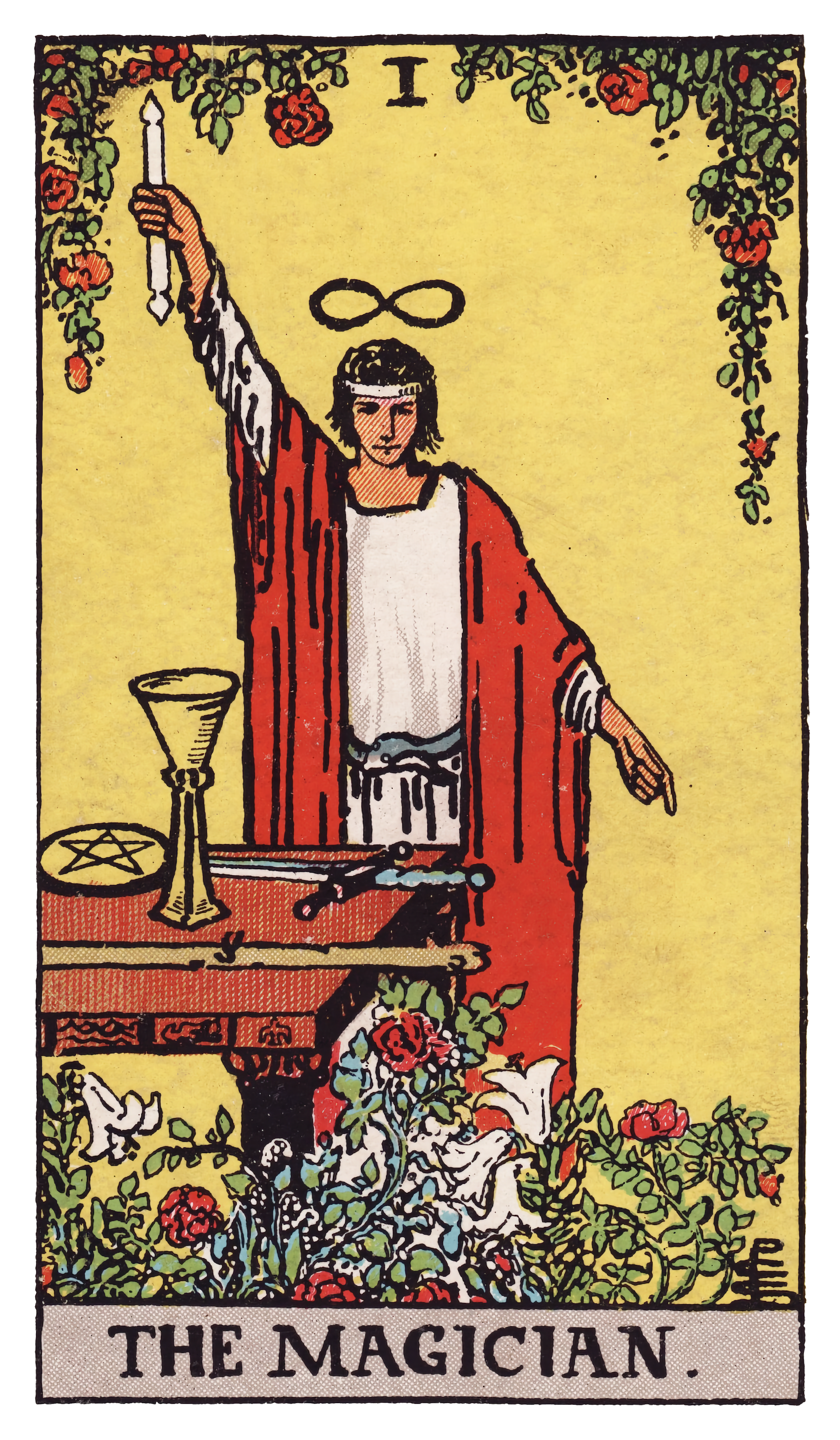
The Imagery and Symbolism
The Magician stands at a table in a walled garden; one hand raised toward the sky and one hand pointing down toward the earth. This gesture gives the card its oldest teaching: as above, so below. What exists in the realm of thought and possibility can be brought down into physical form. The Magician bridges the two.
Above his head floats the lemniscate, the sideways figure eight that represents infinity. It tells us that the power he is demonstrating is not a limited resource. Inspiration, skill, and creative force are not used up when they are spent. They renew themselves endlessly, available again the moment they are called on.
Around his waist is a serpent devouring its own tail, the ouroboros. Like the lemniscate above him, this is another symbol of an endless cycle, here specifically tied to life force and the eternal return of energy that has been used and returned to a form ready to be used again.
His robe is white beneath a red outer garment, the same pairing of purity and passion, of thought and will, that we will see again throughout the Major Arcana. On the table before him are the four suit symbols of the Minor Arcana: a wand, a cup, a sword, and a pentacle. He has fire, water, air, and earth all within reach. Nothing is missing. Every tool a person could need to create something real is already on the table.
Behind him, the garden is full of red roses and white lilies, the same flowers that mark passion and purity elsewhere in the deck. If you have read Part 6 of the Tarot Symbolism Series on plants and flowers, you already know these blooms are never decoration. They are telling you that The Magician’s power is rooted in both desire and clarity of intention at once.
What The Magician Means Upright
Upright, The Magician is one of the most energizing cards in the deck. He represents resourcefulness, skill, and the ability to manifest an idea into something tangible. When he appears, the message is usually direct. You have what you need. The tools, the timing, and the ability are all present. What is being asked of you now is focused action.
This is a card of willpower applied with clarity. Not scattered effort, not wishing, but a deliberate act of will that takes raw potential and shapes it into something real. The Magician doesn’t wait for permission or perfect conditions. He works with what is already on the table.
What The Magician Means Reversed
As we covered in the Upright and Reversed post, a reversed card can point to an opposite meaning, to blocked or delayed energy, or to something happening beneath the surface rather than out in the open. All three show up with The Magician, depending on the reading.
Read as an opposite meaning, The Magician reversed can point to manipulation, trickery, or someone using their skill and charisma for less-than-honest purposes. The same gifts that build can also deceive.
Read as blocked or delayed energy, this reversal often shows up as untapped potential. The tools are still on the table, but they are not being picked up. Self-doubt, distraction, or a simple lack of follow-through is keeping real ability from becoming real results.
Read as something hidden, The Magician reversed can point to a skill or a resource the person has not yet recognized in themselves. The power is there. It has just not been named or claimed yet.
Yes or No: The Magician
As a general yes or no card, The Magician leans strongly toward yes. He is a card of active capability, and his presence in a reading usually confirms that the resources and skill needed for a favorable outcome are already available.
The Magician in Love
In matters of the heart, The Magician often points to intentional, active pursuit of a connection rather than passive waiting. For someone single, this can nudge them to put real effort into meeting people rather than hoping a connection arrives on its own. For someone already in a relationship, The Magician asks what you can actively build or create together right now, using the tools, time, and goodwill already present.
Reversed, this can point to charm being used manipulatively, or to a relationship where one person’s real feelings aren’t being expressed honestly.
The Magician in Career and Finances
Career readings with The Magician usually signal that the skills, resources, or opportunity needed for success are already in place. This is an excellent card for launching a new project, pitching an idea, or stepping into a role that calls for initiative. Financially, The Magician suggests that resourcefulness, not luck, will move things forward. The tools for building wealth or stability are already available; the task now is to use them deliberately.
Reversed, this often points to wasted potential, a good idea not being acted on, or poorly managed resources.
The Magician and Feelings
When a reading is asking how someone feels, The Magician usually points to confidence and clear intention. The person in question likely knows what they want and is not confused about it, even if they have not said it aloud yet.
When The Magician Shows Up in Your Reading
A few questions worth sitting with when this card appears:
- What tools, skills, or resources do I already have that I have not fully used yet?
- Where am I waiting for permission or perfect conditions instead of simply beginning?
- Is my will focused on one clear intention, or is my energy scattered across too many directions?
- Am I using my abilities honestly, or am I cutting corners to get a result I want?
The Magician reminds us that manifestation is rarely about receiving something new from outside ourselves. More often, it is about recognizing what is already within reach and choosing to act.
Final Thoughts
The Magician reminds us that we are rarely as unprepared as we feel. The tools, the timing, and the will are so often already present, waiting only to be picked up and used. Where The Fool teaches us to leap without needing certainty, The Magician teaches us what to do once we land: look at what is already on the table and begin.
Ready to Manifest Your Next Step?
If you are standing in front of an opportunity and want clarity on how to move forward, I would love to read for you. You can order a tarot card reading by email anytime. Coming Up Next
Next time, The Magician steps aside for a very different kind of power. We’ll explore The High Priestess, card two, and the quieter wisdom of intuition, stillness, and what is known without being spoken.
Have you ever pulled The Magician at a moment when you needed to trust your own resourcefulness? I would love to hear about it in the comments.
Kim’s Esoteric Tarot Journals
Tarot readings are intended for adults age 18 and older and are provided for entertainment and personal reflection. Tarot should not replace professional medical, legal, mental health, or financial advice.
© 2026 Kim’s Esoteric Tarot Journals. All rights reserved.
 Kim's Esoteric Tarot Journals
