
Monthly Archives: August 2026

Tarot Symbolism Series: Part 3 – Direction and Body Language

Direction and Body Language illustration featuring tarot figures facing left and right, with symbols for movement, openness, focus, stillness, posture, and gaze.
Direction, posture, and gaze can reveal powerful clues in tarot. Part 3 of the Tarot Symbolism Series explores how body language and the way figures face within a card can add deeper meaning to a reading.

Tarot Symbolism 103: What Posture and Gaze Reveal in the Cards

We have covered two layers of tarot symbolism so far: numerology tells you where a situation sits in its cycle, and color tells you how that situation feels. Today we are adding a third layer: direction and body language. This one tends to surprise people, because once you start seeing it, you cannot unsee it.

Every figure in the Rider-Waite deck is positioned with intention. Which way a character is facing, where their eyes are pointed, whether their arms are open or closed, whether they are standing or seated or on the move: all of it is part of the message the card is delivering. When I pull a tarot card, I always make sure to scan the entire card, including the figures and the direction they are facing. The body rarely lies, and that is just as true in tarot as it is in real life.

Why Body Language Matters in a Reading

Traditional card meanings give you the broad strokes of what a card is about. Body language narrows it down. Two cards can share a similar core meaning but feel completely different depending on how the figures are positioned. A figure facing right carries a different energy than the same figure turned away, even if every other element of the card is identical. Direction tells you where the energy is going. Posture tells you how the figure relates to that energy.

This is especially useful in spreads where you are tracking the movement of a situation over time. Cards whose figures face toward each other suggest connection or momentum. Cards whose figures face away from each other can point to disconnection, diverging paths, or something being left behind. You do not need to analyze every limb of every figure. You just need to notice the dominant impression the posture gives you before anything else.

Direction and Body Language Reference

Here is a quick reference for the most common physical signals in Rider-Waite tarot and what they generally indicate in a reading.

SignalWhat It ShowsGeneral Meaning
Facing rightForward motionMoving toward the future, openness to what is coming
Facing leftLooking backReflection, the past, or resistance to moving forward
Facing forwardDirect engagementConfronting the situation head-on, full presence
Gaze upwardSpiritual focusLooking to higher guidance, hope, or divine connection
Gaze downwardInner focusGrief, contemplation, withdrawal, or shame
Eyes closedInward awarenessIntuition, rest, deep inner knowing, or denial
Arms openReceptivityWelcoming, openness, generosity, or surrender
Arms crossed or heldGuardednessSelf-protection, withholding, or internal conflict
Standing uprightConfidenceAuthority, stability, and readiness to act
SeatedDeliberationStillness, judgment, patience, or established power
Kneeling or bowedHumilityReverence, submission, defeat, or receiving grace
Turned awayAvoidanceRefusal to engage, loss, or moving on from something
Dancing or leapingFreedomJoy, abandon, spiritual liberation, or breakthrough
Figure in motionUrgencyAction underway, speed, or a situation in flux
Figure stillResolutionCertainty, completion, or a moment held in suspension

Quick Examples

The Fool steps forward with his face tilted slightly upward and his arms loose at his sides. Everything about his body language says openness: he is not braced for impact, not looking back, not guarding himself. He is moving into the unknown with complete ease. That posture alone communicates the card’s core energy before you think about the cliff, the dog, or the white sun behind him.

The Two of Swords shows a seated figure with arms crossed and a blindfold over her eyes. She is not moving. She is not looking at anything. Her body is closed off in every direction at once. The message is not just indecision; it is a deliberate refusal to see what is available to see. The posture makes the meaning more specific and more personal than the card’s name alone ever could.

The Eight of Pentacles shows a figure bent over his work, eyes down, focused entirely on the coin in front of him. He is not looking at the coins already finished and hanging behind him. He is not looking ahead. He is just working. That downward gaze and concentrated posture tells you this is a card about diligence and practice, not about pride in what has already been accomplished.

The World shows a dancing figure at the card’s center, body mid-motion, arms extended, face turned slightly to look back over one shoulder. The posture captures both completion and continuation at once. She has arrived somewhere, but she is still moving. That specific body language is doing something a static figure never could.

How to Use This When You Read

When a card lands in a spread, spend a moment with the figures before you reach for a meaning:

•  Which direction is the figure facing, and what does that suggest about the energy at play?

•  Are their arms open or closed? Are they in motion or at rest?

•  Where is their gaze directed, and what does that point toward in the context of your question?

•  If there are multiple figures in the card, how are they oriented in relation to each other?

That last point matters especially in relationship readings. Two figures facing toward each other suggest mutual engagement. Two figures facing away suggest distance or divergence, even if the card’s traditional meaning is a positive one. Let the bodies tell you what the situation actually looks like on the ground.

Direction and body language are meant to add specificity to a reading, not replace the card’s traditional meaning. Keep the question, the position in the spread, and your intuition in the mix. The posture is one more lens, not the whole story.

Coming Up Next

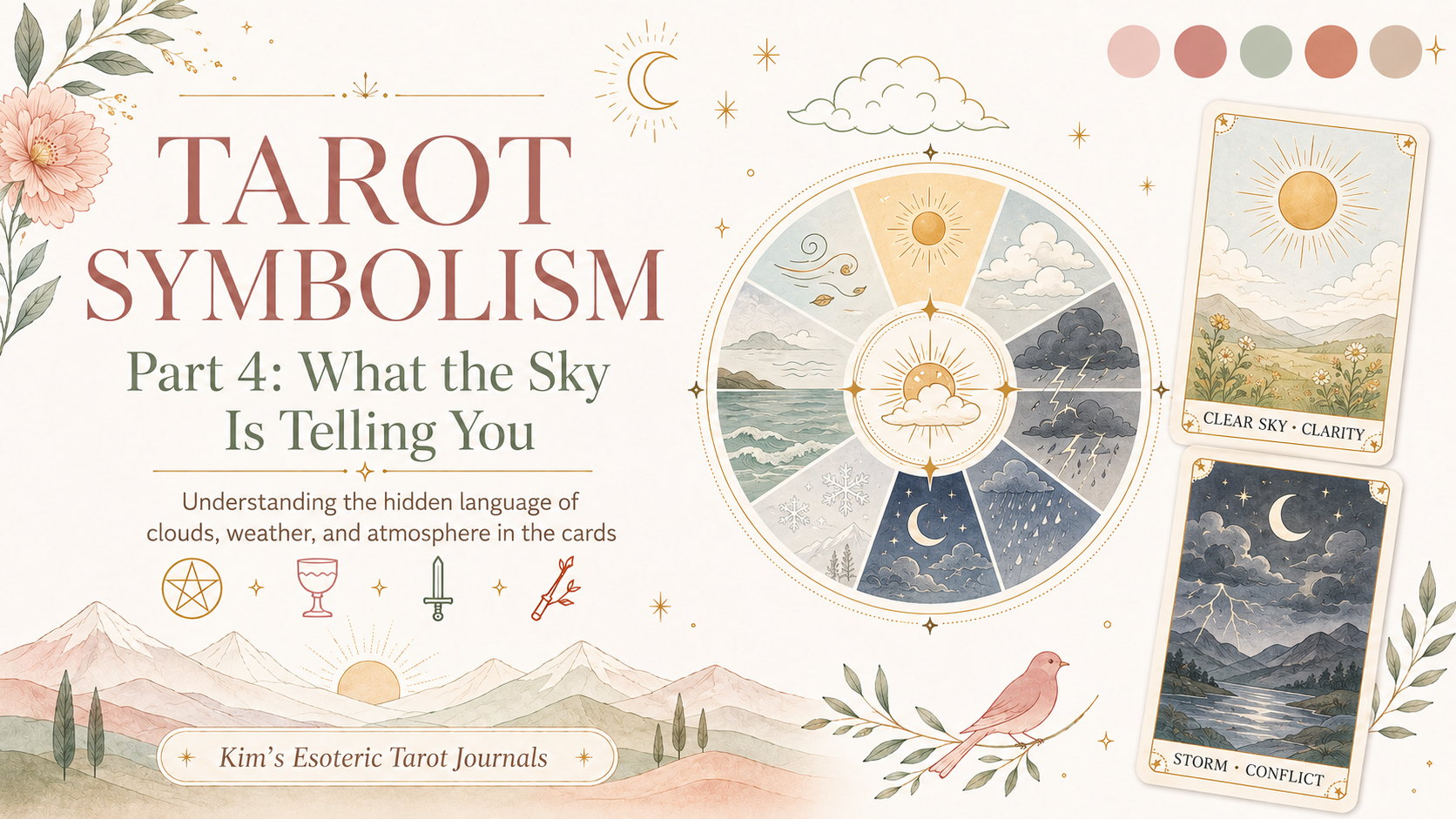
Now that we have covered numerology, color, and body language, we are going to look upward: clouds and weather. The atmospheric conditions surrounding the figures in a card are never accidental. Storm clouds, clear skies, rough seas, and still water all carry meaning, and in the next blog we will work through what the weather is telling you. From there, the series continues through animals, plants and flowers, the four elements, celestial symbols, clothing, objects, landscapes and buildings, and repeated symbols.

Have you started paying attention to the direction figures are facing in your readings? If so, what are your thoughts?

Tarot readings are intended for adults age 18 and older and are provided for entertainment and personal reflection. Tarot should not replace professional medical, legal, mental health, or financial advice.

© 2026 Kim’s Esoteric Tarot Journals. All rights reserved.

Tarot Symbolism Series: Part 2 – Colors

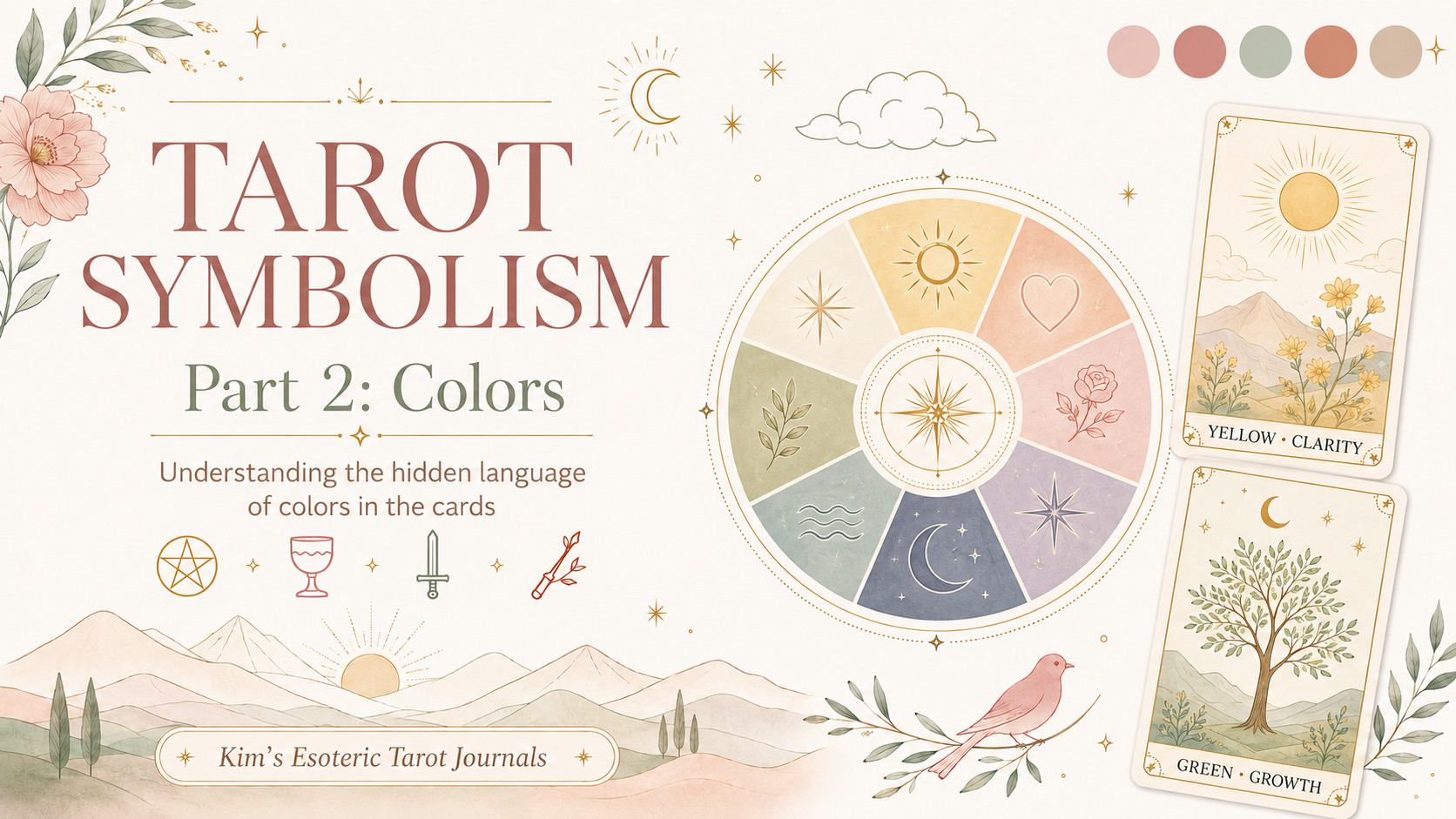
“Tarot Symbolism Part 2: Colors graphic featuring a pastel color symbolism wheel, tarot-inspired cards representing yellow for clarity and green for growth, celestial symbols, flowers, mountains, and botanical illustrations for Kim’s Esoteric Tarot Journals.”
Explore how color adds another layer of meaning to tarot, revealing emotional, spiritual, and symbolic messages woven throughout the cards.

Tarot Symbolism 102: Reading Color in the Cards

Tarot Symbolism 102: Reading Color in the Cards

Last time, we looked at numerology and how the number on a card tells you where a situation sits in its natural cycle. Today we are moving into the next layer of tarot symbolism: color. Color is one of the first things your eye lands on when you pull a card, and it is doing a lot of quiet work before you even start thinking about the card’s traditional meaning.

You have probably already felt this without realizing it. A card dominated by dark grays and blacks reads differently than one filled with gold and white, even before your brain processes the image. The artists behind the Rider-Waite deck did not choose colors at random. Every shade in those illustrations carries meaning, and once you know what to look for, color becomes one of the fastest ways to get an immediate emotional read on a card before you consult any other reference.

What Color Adds to a Reading

Traditional card meanings tell you what a card is about. Color tells you how it feels. A card with warm reds and oranges has a different energy than the same type of card rendered in cool blues and grays, even if the structural meaning is the same. Color speaks directly to the emotional temperature of a situation.

When you are reading a spread, notice whether the cards are dominated by warm tones, cool tones, or a mix. A reading full of warm reds and yellows often signals action, urgency, or passion. A reading heavy in blues and purples tends to point toward inner work, spirituality, or a situation that calls for calm reflection. A mix of dark and light throughout the spread can indicate tension between what is known and what remains unresolved.

Color Chart

Here is a quick reference for the colors most commonly found in Rider-Waite tarot cards and what each one generally brings to a reading.

ColorCore EnergyGeneral Meaning
RedPassionAction, desire, courage, and raw energy
OrangeDriveAmbition, creativity, and enthusiasm
YellowClarityOptimism, intellect, and mental energy
GreenGrowthAbundance, healing, and connection to nature
BlueTruthCalm, communication, intuition, and spiritual awareness
Purple / VioletWisdomMysticism, higher knowledge, and spiritual depth
WhitePurityClarity, innocence, spiritual protection, and new beginnings
BlackMysteryThe unknown, transition, endings, and the subconscious
GrayNeutralityUncertainty, ambiguity, and situations not yet resolved
BrownGroundingPracticality, stability, and connection to the earth
GoldRadianceDivine energy, success, spiritual illumination, and high achievement

Quick Examples

The Fool is surrounded by white and yellow. The white sun behind him signals purity and divine protection. The yellow background reinforces optimism and the open, unguarded energy of someone stepping into something entirely new. Even before you think about the cliff or the little dog, the color palette alone tells you this is a card of bright, unfiltered possibility.

The High Priestess is almost entirely blue. Her robes, the curtain behind her, and the water at her feet all carry that cool, still, inward quality. Blue here is not melancholy. It is the color of deep knowing, intuition held quietly rather than spoken aloud. The card feels calm because it is meant to. That stillness is the point.

Compare that to The Tower. The dark sky, the gray stone, and the burst of orange and red flames tell the story before you read a single word. The warm tones of fire against the cold structure signal sudden disruption. Nothing about that color palette is comfortable, and it is not supposed to be.

The Star brings a shift back to blues and soft neutrals, with a single figure pouring water under a clear sky full of stars. After the chaos of The Tower, the color palette alone signals relief and renewal. Even without knowing anything else about the card, it reads as calmer and more hopeful than what came before it.

How to Use This When You Read

When a card comes up in a spread, try asking a few quick questions about its color:

•  What is the dominant color on this card?

•  Does the color feel warm, cool, or neutral?

•  Does the color match or contrast with the card’s traditional meaning?

•  Is this color repeated anywhere else in the spread?

That last question is worth sitting with. When the same color appears across multiple cards in a spread, it is rarely a coincidence. A spread with blue showing up in three or four cards is pointing toward a theme of intuition, communication, or spiritual awareness, even before you read the individual cards in detail. Color repetition strengthens a message the same way number repetition does.

Color is meant to add depth to a reading, not replace the card’s traditional meaning. Keep the question, the position in the spread, and your intuition in the mix.

Coming Up Next

Color is just one more layer of the symbolic language running through every tarot card. In the next blog, we will look at direction and body language: what a figure’s gaze, posture, and position on the card reveal about the energy at play. From there, the series continues through clouds and weather, animals, plants and flowers, the four elements, celestial symbols, clothing, objects, landscapes and buildings, and repeated symbols.

Have you started noticing color in your readings? If so, what are your thoughts?

Tarot readings are intended for adults aged 18 and older and are provided for entertainment and personal reflection. Tarot should not replace professional medical, legal, mental health, or financial advice.

© 2026 Kim’s Esoteric Tarot Journals. All rights reserved.
Tarot Symbolism Series: Part 1 – Numerology

**Alt text:**
Tarot Symbolism 101 blog graphic featuring two numbered tarot cards, a crescent moon, crystals, flowers, and the title “Part 1: Numerology” for Kim’s Esoteric Tarot Journals.
Explore the hidden language of tarot through numerology and discover how numbers help reveal the deeper story within the cards.

Tarot Symbolism 101: Understanding Numerology in the Cards

Before we get into individual meanings for each tarot card in future blogs, I want to spend a little time on tarot symbolism.

This builds on the foundation from the Major Arcana and Minor Arcana overviews, so if you haven’t read those yet, they’re a great place to start.

Every tarot card is more than its name and traditional meaning. Each image is built from layers of symbolism, including colors, numbers, animals, clothing, weather, objects, and landscapes. See the full list below. Once you learn to read these details, you stop memorizing definitions and start seeing the story each card is telling.

This post kicks off a series on tarot symbolism. Below is a quick look at the types of symbols we will cover, followed by a deep dive into the first one: numerology.

Types of Tarot Symbolism

  • Numerology – the meaning of numbers and numerical cycles
  • Colors – how color influences the mood of a card
  • Direction and body language – what a figure’s gaze or posture reveals
  • Clouds and weather – the atmosphere surrounding a situation
  • Animals – instinctive and spiritual meanings
  • Plants and flowers – symbolism found in nature
  • The four elements – Fire, Water, Air, and Earth
  • Celestial symbols – the Sun, Moon, stars, and planets
  • Clothing – what robes, crowns, and armor reveal
  • Objects – keys, swords, cups, and other meaningful items
  • Landscapes and buildings – mountains, towers, bridges, and paths
  • Repeated symbols – patterns that strengthen a message

First Up: Numerology

Numerology looks at how numbers shape the meaning of a card. The number tells you where a situation sits in its natural cycle: just beginning, developing, stable, being challenged, or wrapping up. The suit tells you which area of life that energy is showing up in.

  • Wands – passion, creativity, and action
  • Cups – emotions, relationships, and intuition
  • Swords – thoughts, communication, and conflict
  • Pentacles – money, work, and physical security

Numerology Chart

NumberCore EnergyGeneral Meaning
0PotentialFreedom, possibility, and stepping into the unknown
1BeginningInitiative, opportunity, and new starts
2BalancePartnership, choices, and patience
3GrowthCreativity, communication, and expansion
4StabilityStructure, security, and strong foundations
5ChangeConflict, disruption, and necessary adjustment
6HarmonyHealing, support, and restored balance
7AssessmentReflection, strategy, and discernment
8PowerMomentum, discipline, and mastery
9CulminationWisdom, resilience, and near completion
10CompletionFulfillment, closure, and renewal

Quick Examples

The Two of Cups and the Two of Swords both carry the balancing energy of Two, but the suit changes the story. The Two of Cups often points to connection, partnership, or mutual attraction, while the Two of Swords often points to a difficult choice or feeling stuck between two options. Same number, same underlying theme of balance, but a very different experience depending on the suit.

The same pattern shows up with the Five of Cups and the Five of Pentacles. Both carry the disruptive energy of Five, but they show up in different areas of life. The Five of Cups often points to grief or disappointment, while the Five of Pentacles often points to money, job loss, or feeling left out. The number sets the theme, and the suit shows you where that theme is playing out.

How to Use This When You Read

Next time a numbered card shows up in a reading, ask a few quick questions:

  • What does this number generally represent?
  • What area of life does the suit point to?
  • Is this number repeated elsewhere in the spread?

Numerology is meant to add depth to a reading, not replace the card’s traditional meaning. Keep the question, the position in the spread, and your own intuition in the mix too.

Coming Up Next

Numerology is just one layer of tarot’s symbolic language. In the next blog, we will work through colors before continuing on to the rest of the series: direction and body language, clouds and weather, animals, plants and flowers, the four elements, celestial symbols, clothing, objects, landscapes and buildings, and repeated symbols.

Have you used tarot symbolism in your readings? If so, what are your thoughts?

Tarot readings are intended for adults age 18 and older and are provided for entertainment and personal reflection. Tarot should not replace professional medical, legal, mental health, or financial advice.© 2026 Kim’s Esoteric Tarot Journals. All rights reserved.