
The Fool Tarot Card Meaning: The Leap Into New Beginnings

Use:

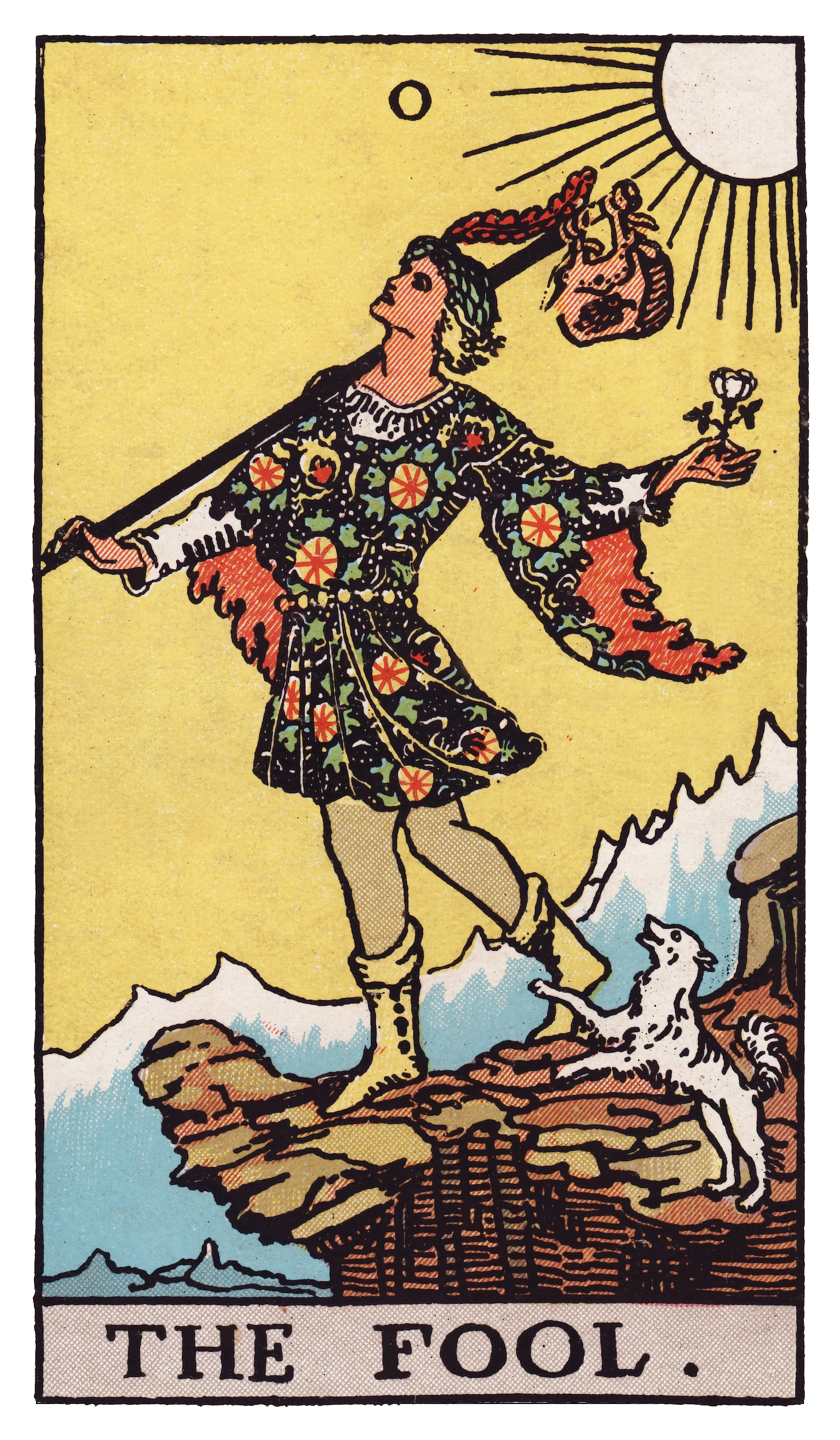
The Fool tarot card from the Rider-Waite-Smith deck, showing a traveler standing near a cliff with a small white dog, holding a white rose and carrying a bundle over one shoulder.*
The Fool, card 0 of the Major Arcana. New beginnings, faith in the unknown, and the courage to take the first step.

In my Major Arcana Overview, I promised that each of the twenty-two cards would get its own dedicated conversation. So it only makes sense to begin where the story itself begins, with card zero, The Fool. Every journey through the Major Arcana starts here, and so does every reader’s relationship with the deck. If you understand The Fool, you understand the spirit in which the whole Fool’s Journey is meant to be walked. As always, everything here follows the Rider-Waite tarot.

The Card at a Glance

  • Number: 0
  • Keywords: New beginnings, innocence, spontaneity, faith, freedom, potential
  • Element: Air
  • Reversed Keywords: Recklessness, naivety, hesitation, fear of the unknown
  • Yes or No: Yes

What You See in the Card

The Fool is one of the most recognizable images in the entire deck. A young traveler stands at the very edge of a cliff, face turned upward toward the sky, seemingly unaware (or perhaps unconcerned) that his next step could carry him over the edge. He is dressed in a bright, patterned tunic, carries a small bundle tied to a staff over his shoulder, and holds a single white rose in his other hand. A little white dog leaps at his heels. Behind him, a bright sun shines in a golden yellow sky, and in the distance, cold white mountain peaks rise up.

At first glance, it looks like a card about carelessness. Look a little longer, and you start to see it is really a card about trust.

The Symbolism, Piece by Piece

The cliff’s edge. This is the threshold. The Fool is standing at the exact moment before something begins, when everything is still possible and nothing has been decided. The edge represents risk, but also invitation. You cannot begin anything new without stepping into the unknown.

The upward gaze. The Fool is not looking down at the drop. He is looking up, toward the sky and the sun. This is faith in its purest form: a belief that life will support him, even without a map.

The small bundle. Everything he owns fits in one little pack. The Fool travels light. He carries only what he needs, and some readers see the bundle as holding the memories and lessons he has yet to gather. He is not weighed down by past experience, which is exactly what allows him to move so freely.

The white rose. In the language of tarot colors, white is purity and innocence. The rose represents an open heart and pure intentions. The Fool is not setting out to deceive or conquer anyone. He is simply setting out.

The white dog. The dog is loyalty, instinct, and protection. Some see it as trying to warn The Fool of the edge, others as cheering him on. I like to read it as both. It is that small, loyal voice of instinct that travels with us, the part of us that notices things our excitement might miss.

The sun and yellow sky. The bright sun behind him signals optimism, vitality, and divine support. Yellow in tarot often speaks to the mind, energy, and enthusiasm. The whole card is bathed in warmth and possibility.

The mountains. Those distant, icy peaks represent the challenges and lessons waiting further down the road. The Fool doesn’t know about them yet. He will. That is what the rest of the Major Arcana is for.

Why Zero Matters: The Numerology of The Fool

In Part 1 of my Tarot Symbolism Series on numerology, zero sits at the very top of the chart, and its core energy is potential: freedom, possibility, and stepping into the unknown. There is no card that embodies that energy more completely than The Fool.

Zero is not “nothing.” It is the empty circle that holds every possibility before any of them has taken form. In the Minor Arcana, the numbers begin at one with the Aces, the first spark of something new. The Fool comes before even that. He is the moment before the moment, the breath you take before you speak. Where One is the beginning, Zero is the pure potential that makes a beginning possible at all.

This is also why The Fool is seen as both the start of the Major Arcana and the traveler who moves through every card that follows. The Magician, The Empress, The Tower, The Star: these are all places The Fool visits and lessons he learns. When he reaches The World at card twenty-one, the circle of zero closes into completion, and the journey can begin again at a new level.

The Fool Upright

When The Fool appears upright in a reading, something new is opening up in your life. It might be a new job, a move, a relationship, a creative project, or simply a fresh way of seeing yourself. This card encourages you to say yes, to trust your timing, and to take the leap even if you don’t have every answer yet.

I often tell my clients that The Fool is permission to be a beginner. It allows you not to know, and to follow curiosity rather than a five-year plan. If you have been waiting until you feel completely ready, The Fool gently reminds you that readiness often arrives after the first step, not before it.

The Fool Reversed

Reversed, The Fool’s energy can tip in one of two directions, and your intuition (along with the surrounding cards) will help you sense which one applies. If you are still getting comfortable with reversals, my post on reading both sides of the card is a good companion to this section.

The first direction is recklessness. This is the Fool who jumps without looking at all, ignoring the dog’s warning and every sensible sign around him. It can point to poor judgment, rushing into commitments, or taking risks that aren’t grounded in reality.

The second is the opposite: hesitation. This is the Fool who stands at the edge and never moves. Fear of the unknown, fear of looking foolish, or fear of failure keeps a new beginning from ever starting. Sometimes the reversed Fool simply asks, “What are you so afraid of?”

The Fool in Love, Career, and Finances

Love

For someone single, The Fool often signals a fresh romantic chapter, a new person, or simply a renewed openness to love. It can arrive unexpectedly and feel light, fun, and exciting. In an existing relationship, The Fool invites adventure and a fresh start together, whether that is a move, a trip, or rediscovering playfulness. Reversed, it can point to someone who isn’t ready to commit, or to rushing into something before you really know the other person.

Career

In career readings, The Fool is a classic sign of a new job, a career change, a new business, or a leap into unfamiliar territory. It favors taking the opportunity, even if you feel underqualified or unsure. Reversed, it may warn against quitting on impulse without a plan, or it may reveal that fear is keeping you in a role you have already outgrown.

Finances

Financially, The Fool can point to a new venture, a fresh approach to money, or a willingness to take a calculated risk. Because the card is so spontaneous, it also asks you to keep one eye on the edge of the cliff. Reversed, it often cautions against impulsive spending, gambles, or financial decisions made on excitement alone.

Is The Fool a Yes or No Card?

Upright, The Fool is a yes. It is one of the most encouraging cards in the deck when you are asking whether to begin something, take a chance, or follow a new path. Just remember the dog at his heels: it is a yes that still asks you to look where you’re stepping.

Reversed, The Fool leans toward no, or more accurately, not yet. It suggests either slowing down and planning more carefully, or examining the fear that is holding you back before you move forward.

When The Fool Shows Up in Your Reading

Because The Fool is a Major Arcana card, its appearance signals that something meaningful is starting, not just a passing whim. Pay attention to where it lands in a spread. In a past position, it may point to the beginning of the situation you are now asking about. In a present position, you are standing at the edge right now. In a future or outcome position, a fresh start is on its way.

Here are a few questions to sit with when The Fool comes up for you:

  • What new beginning is calling to me right now?
  • Where am I holding back because I don’t feel “ready”?
  • What would I do if I trusted that life would support me?
  • Is my excitement being balanced by my instincts, or overriding them?

Final Thoughts

The Fool reminds us that every great story starts with someone willing to take a first step without knowing how it ends. There is wisdom in that kind of innocence. We move through the Fool’s Journey many times across our lives, and each time we return to zero, we get to begin again with open hands and an open heart.

Standing at Your Own Cliff’s Edge?

If you are facing a new beginning and want some clarity before you take the leap, I would love to read for you. You can order a tarot card reading by email anytime.

Coming Up Next

Next time, The Fool meets his first teacher. We’ll explore The Magician, card one, and what it means to realize you already hold every tool you need.

Have you ever had The Fool show up at a turning point in your life? I’d love to hear about it in the comments.

Kim’s Esoteric Tarot Journals

Tarot readings are intended for adults age 18 and older and are provided for entertainment and personal reflection. Tarot should not replace professional medical, legal, mental health, or financial advice.

© 2026 Kim’s Esoteric Tarot Journals. All rights reserved.
Upright and Reversed: Reading Both Sides of the Card

We have now completed our twelve-part Tarot Symbolism Series. Whether it refreshed what you already knew or gave you a few new takeaways to carry into your own readings, I hope you enjoyed working through the series.  Before we move into interpreting individual tarot cards, starting with the Major Arcana, I want to first address reading tarot cards upright and reversed. Not everyone reads reversals, and you are certainly not required to. Reading reversals, however, can add another layer of depth to your readings.

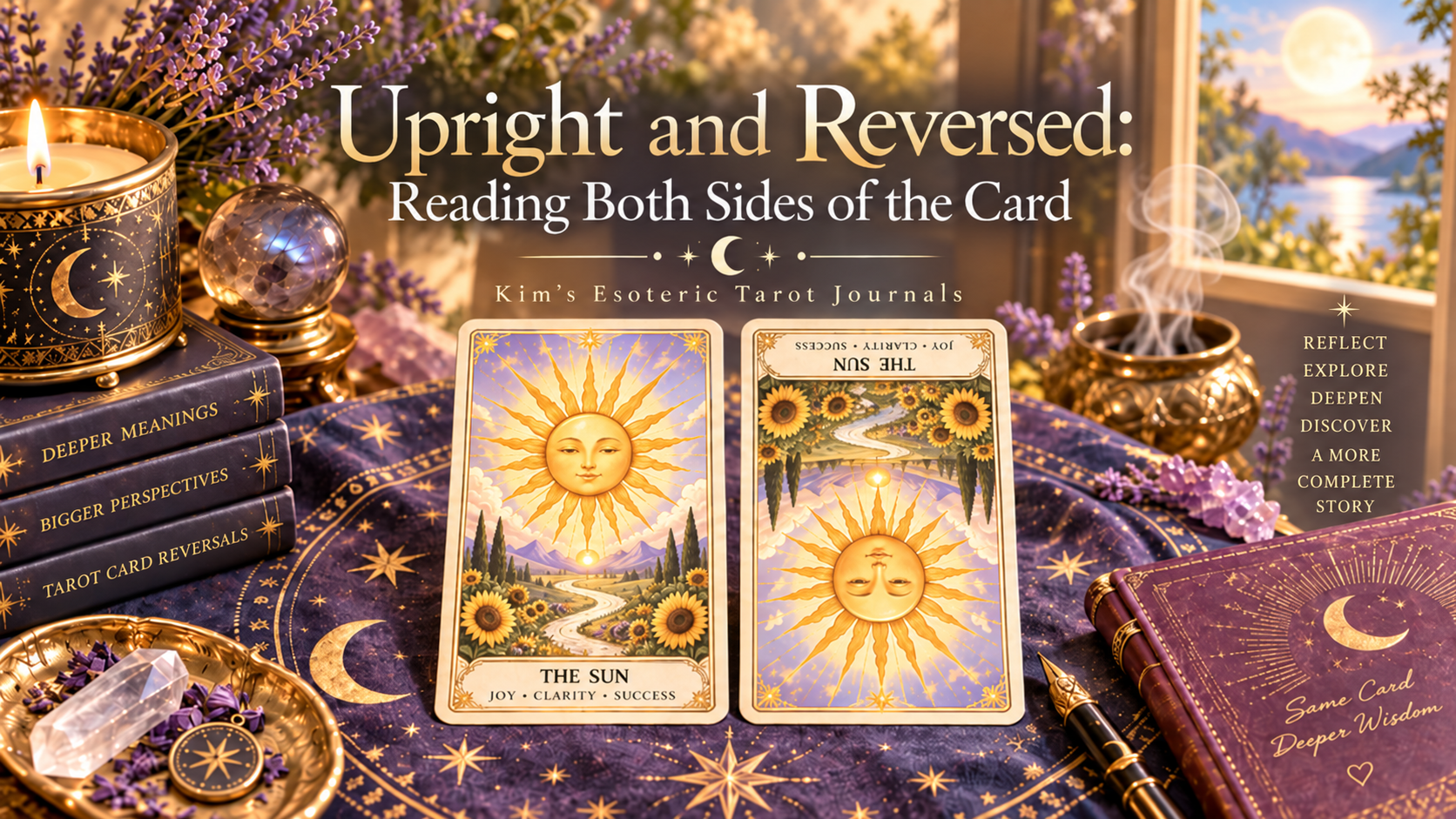
Two Sun tarot cards, one upright and one reversed, displayed on a bright celestial tarot table with candles, crystals, books, and mystical decor.
Upright and reversed Sun tarot cards illustrate how a card’s core meaning can shift in expression while still holding the same underlying energy.

If you have ever pulled a card and watched it land upside down in your spread, you already know the small jolt of uncertainty that follows. Do you turn it right-side up and read it as usual? Do you sigh and brace for bad news? Almost every reader asks this question at some point, and the honest answer is that reversals are one of the most misunderstood parts of tarot practice. They are not complicated once you understand what they are actually doing. The cards just need a little unpacking.

This post walks through upright and reversed meanings in plain language, without turning it into a memorization exercise. By the end, you should have a simple, steady way of thinking about reversals that you can carry into every reading from here forward.

What an Upright Card Is Really Telling You What an Upright Card Is Really Telling You

An upright card is the clearest, most direct version of its meaning. The card’s energy flows the way it naturally wants to, fully expressed and out in the open. If the Six of Wands appears upright, you are looking at recognition, success, and a win others can see. Nothing about it is hidden or held back. Reading upright cards is really just learning the base meaning of each card, since that meaning is what you see at full strength.

This is why most beginners start with upright meanings only. It gives you a solid foundation, a plain and reliable version of each card’s story, before you start layering in the more subtle question of direction.

What Changes When a Card Is Reversed

When a card comes out reversed, nothing about its core meaning disappears. The same themes, energy, and underlying story are still present. What changes is how that energy is showing up in the situation. There are three common ways experienced readers describe this shift, and you will find yourself reaching for different ones depending on the card and the question in front of you.

The first is the opposite meaning. Here, the reversed card is read as the flip side of its upright self. The Two of Cups upright speaks to a strong mutual connection, so reversed it can point to a disconnect, an imbalance, or a relationship that has grown one sided.

The second is blocked or delayed energy, and this is the lens I reach for most often in my own readings. Rather than flipping the meaning entirely, the reversed card says that the upright energy is still true and still on its way, it is just being held up. Something is slowing it down, whether that is outside circumstances, self doubt, timing, or resistance from the person or situation involved. The Six of Wands reversed, in this reading, does not mean failure. It means the recognition or success is delayed, quieter than expected, or not yet visible to others.

The third is an internal or hidden version of the upright meaning. Instead of showing up outwardly, the energy is happening privately, beneath the surface. The Three of Swords upright shows heartbreak that is out in the open and being processed. Reversed, that same heartbreak may be present but kept quiet, an old wound being worked through internally rather than shared.

None of these three lenses is the single correct way to read every reversal. Most readers move intuitively between them naturally, guided by the card itself and by the question being asked.

A Simple Way to Choose the Right Lens

If you are new to reversals, here is a starting point that keeps things simple rather than overwhelming. Look at what the upright card is fundamentally describing.

If the card describes an action or a forward movement, something like a journey, a decision, a victory, or a change taking place, a reversal will usually read most naturally as blocked or delayed energy. The movement the card describes is not happening as smoothly or as quickly as it would upright.

If the card describes an emotional state or an inner quality, something like love, fear, generosity, or grief, a reversal will usually read most naturally as that quality turned inward, suppressed, or expressed in its shadow form rather than its healthy form.

This is not a rigid rule, and tarot rarely rewards rigid rules. It is simply a place to start so that reversals stop feeling random and start feeling like an extension of the meaning you already know.

Three Examples

The Sun upright is warmth, clarity, joy, and success that is easy and unclouded. Reversed, the Sun does not become darkness. It becomes joy that is delayed or dimmed, a success that has not fully arrived yet, or happiness that is present but harder to feel right now than it should be. The light is still there. It is just partially blocked.

The Tower upright is sudden, disruptive change, the kind that tears down something that was never as stable as it looked. Reversed, the Tower often points to a collapse that is being avoided or delayed rather than one that has already happened. The instability is real and building, but the person involved may be resisting the change, bracing against it, or postponing an ending that is coming regardless.

The Six of Swords upright is a quiet, steady movement away from difficulty and toward calmer waters, a transition already underway. Reversed, that same journey is stalled. The person may be struggling to leave a difficult situation behind, feeling stuck despite knowing they need to move on, or moving through the transition much more slowly and painfully than the upright card would suggest.

A client of mine once pulled the Six of Swords reversed in a reading about a job she knew she needed to leave. She told me right away that she already understood what the card meant; she just did not understand why she still felt so stuck. That is exactly what a reversed Six of Swords so often describes. The direction is clear and the decision has already been made in her heart. What the reversal was showing was the very real friction of actually making the move, the fear, the practical obstacles, and the part of her that was still holding on. Naming that gap between knowing and doing gave her something concrete to work with, rather than a vague sense that something was wrong.

Do You Have to Read Reversals at All

No. Plenty of skilled, experienced readers choose not to use reversals and read every card upright, drawing out the shadow side or the challenge of a card from its imagery and its context in the spread rather than from its orientation. This is a completely valid way to read, and it is worth trying if reversals ever start to feel more confusing than illuminating. Tarot does not require reversals to be a legitimate or effective practice. It only requires that whatever method you choose, you use it consistently and with attention.

If you do want to work with reversals, the best way in is simply practice. Pull a card, decide which of the three lenses feels most true for that card and that moment, and read it that way. Over time you will notice patterns in your own instincts, and reversals will start to feel less like a puzzle to solve and more like another voice the deck uses to speak to you.

Reading tarot well has never been about memorizing a fixed meaning for every possible position a card can land in. It is about learning to listen closely enough that the card tells you which meaning it is offering, upright or reversed, in this reading, for this question, right now.

Thank you for reading, and for sticking with me through the wrap-up of the Symbolism Series and now into this look at reversals. Do you read reversals in your own practice, and if so, which lens do you reach for most: the opposite meaning, blocked energy, or something hidden beneath the surface? I would love to hear your thoughts.

Tarot readings are intended for adults age 18 and older and are provided for entertainment and personal reflection. Tarot should not replace professional medical, legal, mental health, or financial advice.

© 2026 Kim’s Esoteric Tarot Journals. All rights reserved.
Tarot Symbolism Series: Part 12 – Repeated Symbols

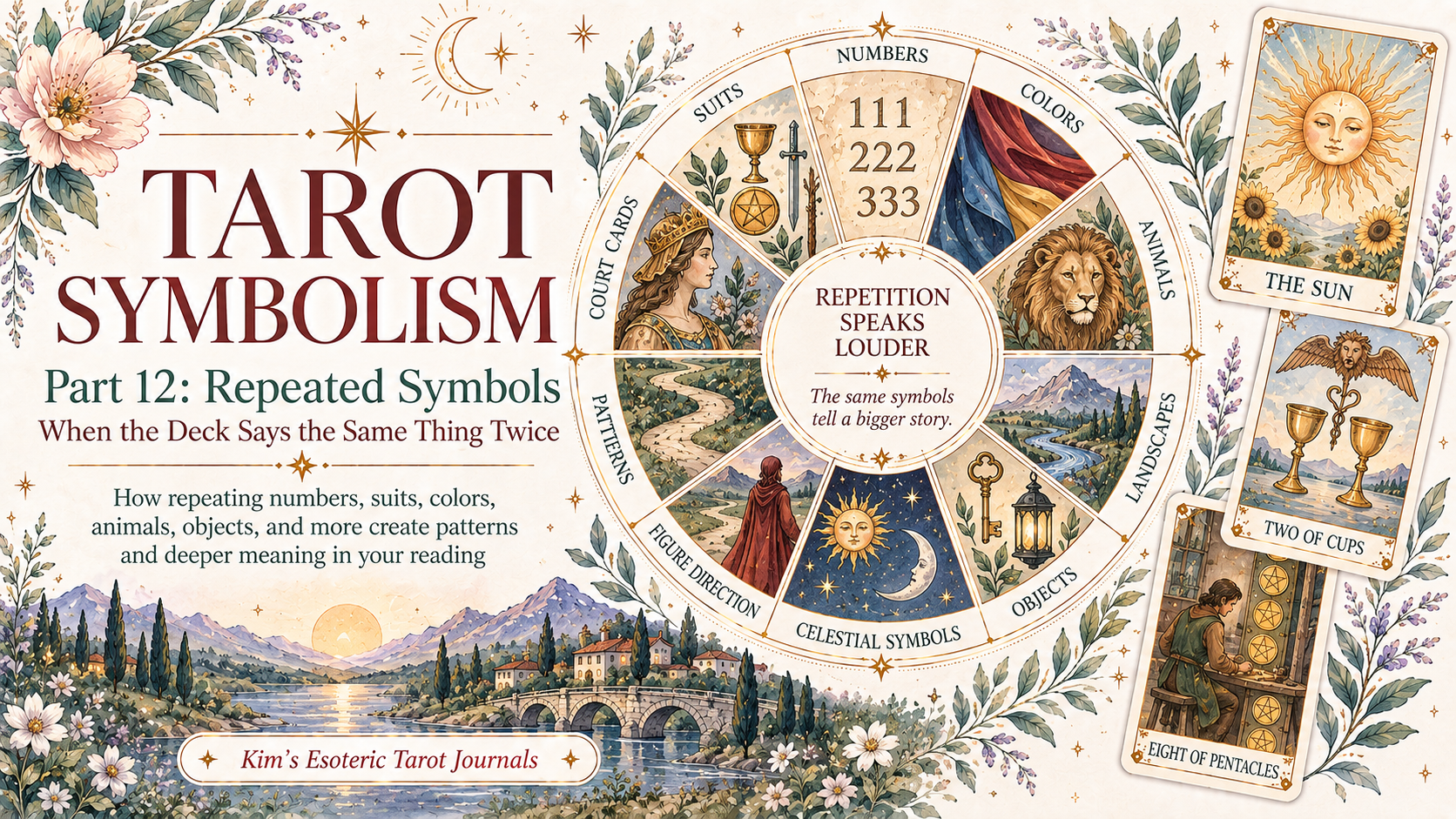
Alt text: Tarot Symbolism Part 12 illustration showing repeated symbols such as numbers, suits, colors, animals, objects, landscapes, and celestial imagery across a tarot spread. A central wheel highlights how recurring patterns can strengthen the message of a reading.
Repeated symbols in tarot reveal the deeper patterns, themes, and connections that tie an entire spread together.

Tarot Symbolism 112: When the Deck Says the Same Thing Twice

This is the final post in the Tarot Symbolism Series. Over the past eleven posts we have worked through every major layer of symbolic language using the Rider-Waite deck: numerology, color, direction and body language, clouds and weather, animals, plants and flowers, the four elements, celestial symbols, clothing, objects, and landscapes and buildings. Today we are pulling all of that together to look at what happens when the same symbol appears more than once in a reading.

Repeated symbols are one of the most powerful things a spread can show you, and one of the least discussed. Most readers learn to read individual cards. Fewer learn to read the patterns running across the cards as a whole. That pattern-reading is where some of the deepest and most specific information in a reading lives. When the deck says the same thing twice, it is not an accident. It is an emphasis, and it is worth stopping to hear what is being repeated and why.

Why Repetition Matters

Every symbolic layer we have covered in this series operates at the level of the individual card. The color of a robe, the phase of the moon, the posture of a figure: these are details you read within a single card and then carry into your understanding of that card’s meaning. Repeated symbols work differently. They operate at the level of the spread as a whole, and they reveal patterns that no single card could show you on its own.

Think of it this way. If one card in a spread shows a figure facing left, that is a detail. If three cards in a spread show figures facing left, that is a theme. The spread is not just showing you three separate situations. It is showing you a reading dominated by backward-looking energy, by reflection, by the pull of the past. That is a very different conversation than the one you would have reading each card individually, and you can only see it by looking at the spread as a whole.

Repetition in tarot functions the same way it does in any other form of communication. When something is said once, you note it. When it is said again, you pay closer attention. When it appears a third time, you stop what you are doing and listen. The deck is always communicating. Repeated symbols are the moments when it raises its voice.

What to Look For

Before diving into the reference table, here is a practical starting point. After you lay out a spread, before you read any individual card, scan the spread as a whole and ask yourself these four questions:

•  Is one suit appearing more than the others?

•  Is one number appearing more than once?

•  Is one color, animal, landscape feature, or object showing up across multiple cards?

•  Are the figures in the spread generally facing the same direction, or are they scattered?

You will not always find a strong repeated pattern, and that is fine. A spread with balanced variety across suits, numbers, and imagery is telling you that the situation has many different elements in play without a single dominant force. But when a pattern does emerge, it is almost always the most important thing the reading has to say, and it deserves to be named before you read any individual card.

Repeated Symbols Reference

Here is a quick reference for the most common repeating patterns and what they generally signal in a reading.

Repeated PatternWhat It SignalsHow to Read It
Same suit appearing multiple timesElemental dominanceOne area of life is driving the reading: fire, water, air, or earth energy is running the show
Same number appearing multiple timesNumerological themeThe energy of that number is the thread connecting the situation across all of its different areas
Same color across multiple cardsTonal consistencyA single emotional or spiritual quality is present throughout, coloring every part of the situation
Same animal across multiple cardsInstinctive threadA particular quality of instinct, loyalty, power, or wildness is running through the reading as a whole
Same landscape feature repeatedSituational patternThe conditions of the situation are consistent across time or across different areas of the question
Same celestial body repeatedCosmic emphasisA specific kind of spiritual or cyclical influence is present throughout the entire reading
Same object appearing multiple timesRecurring toolSomething specific is at the center of the situation in every area it touches
Court cards from same suitPersonality patternA particular type of energy or person is showing up in multiple roles across the reading
Multiple Major Arcana cardsElevated stakesThe situation involves forces larger than the immediate moment, things that carry real weight and consequence
No Major Arcana presentPersonal agencyThe situation is in the hands of the people involved; external fate is not the dominant factor here
Figures facing each otherDialogue or tensionTwo forces, people, or parts of the situation are in direct relationship, for better or worse
Figures all facing awayAvoidance or dispersalEnergy is moving outward or away; connection between the elements of the situation is weak or broken
Repeating elemental contrastUnresolved tensionTwo opposing energies are present throughout the reading without resolution, a situation still finding its balance

Quick Examples

A client once brought me a five-card spread in which four of the five cards were Cups. Before I said a single word about any individual card, I told her that this reading was primarily about her emotional life, her relationships, and her inner world, and that whatever question she had asked was going to find its answer there rather than in practical action or mental clarity. She had asked about a career decision. The Cups did not change the question, but they told her clearly that the real heart of the decision was an emotional one, not a strategic one. That was the most useful thing the spread had to say, and it came entirely from the repeated suit.

A three-card spread showing the Two of Swords, the Four of Swords, and the Eight of Swords has a repeated number pattern worth noting: two, four, and eight are all even numbers and all carry the energy of stillness, waiting, and held or blocked energy. Even before you read the individual cards, the numerological pattern is pointing toward a situation that is paused, suspended, or deliberately immobilized. The specific details of each card then tell you how and why.

When the same animal appears across multiple cards in a spread, I always pause and name it for my client. If dogs are showing up in two or three cards, something about loyalty, faithfulness, or instinctive trust is a thread running through the entire situation. If serpents appear more than once, questions of wisdom and temptation or cycles of transformation are woven through the reading in a way that a single serpent in a single card would not convey. The animal is not just a detail in those individual cards. It is a character in the reading as a whole.

Multiple Major Arcana cards in a single spread always get my attention. When three or more Majors appear together, the reading is no longer primarily about day-to-day circumstances. Something of real weight is in motion: an archetypal force, a significant life transition, or a situation that carries consequences beyond the immediate moment. I tell my clients to sit with those readings longer than they might otherwise. The Majors are asking for it.

How to Put the Whole Series Together

Now that all twelve layers are in place, here is how I recommend building them into your reading practice. You do not need to consciously check all twelve layers on every card. That would make reading feel like an exam rather than a conversation. Instead, work with them as a background awareness that sharpens over time.

•  Start with the spread as a whole: suit distribution, number patterns, and dominant colors before you read any single card.

•  Then read each card starting with its biggest impression: what does the overall image communicate before you analyze any detail?

•  Layer in the specific symbolism that stands out: a striking posture, an unexpected animal, a landscape that feels significant.

•  Close by asking what the spread is saying as a whole: what repeated patterns emerged, and what do they mean for the question at hand?

The twelve layers of symbolism in this series are not a checklist. They are a vocabulary. The more fluently you speak them, the less you will need to think about them consciously, and the more naturally the deeper meaning of each card and each spread will surface on its own. That is what it means to read tarot rather than translate it.

I started this series by saying that every tarot card is more than its name and traditional meaning. I hope by now you can see exactly what I meant. Each card is a complete symbolic world, and the more of that world you can read, the richer and more specific your readings become. The symbolism is always there. It has just been waiting for you to look. Always use your intuition when doing so.

What Comes Next

The Tarot Symbolism Series is now complete. From here, the blog moves into individual card studies, beginning with the Major Arcana one card at a time. Each post will put everything from this series to work: reading the number, the colors, the figures’ posture and clothing, the landscape, the objects, the animals, and the celestial details of a single card in depth. If you have been following along through all twelve parts of this series, those individual card posts are where the real payoff begins.

Thank you for working through this series with me. What has been the most useful layer of symbolism for your own readings? I would love to hear your thoughts.

Tarot readings are intended for adults age 18 and older and are provided for entertainment and personal reflection. Tarot should not replace professional medical, legal, mental health, or financial advice.

© 2026 Kim’s Esoteric Tarot Journals. All rights reserved.