
Tag Archives: Tarot Symbolism

Tarot Symbolism Series: Part 12 – Repeated Symbols

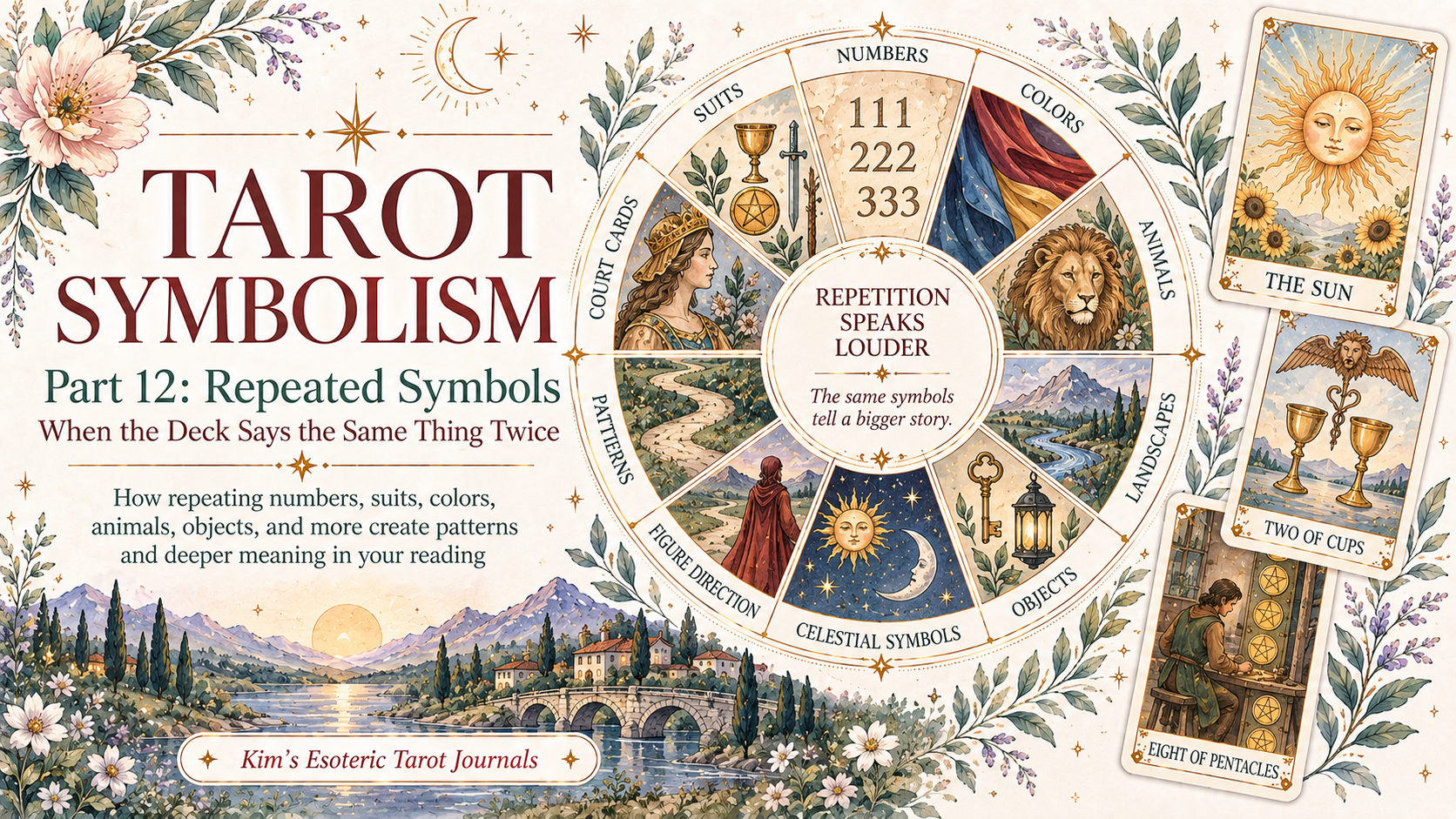
Alt text: Tarot Symbolism Part 12 illustration showing repeated symbols such as numbers, suits, colors, animals, objects, landscapes, and celestial imagery across a tarot spread. A central wheel highlights how recurring patterns can strengthen the message of a reading.
Repeated symbols in tarot reveal the deeper patterns, themes, and connections that tie an entire spread together.

Tarot Symbolism 112: When the Deck Says the Same Thing Twice

This is the final post in the Tarot Symbolism Series. Over the past eleven posts we have worked through every major layer of symbolic language using the Rider-Waite deck: numerology, color, direction and body language, clouds and weather, animals, plants and flowers, the four elements, celestial symbols, clothing, objects, and landscapes and buildings. Today we are pulling all of that together to look at what happens when the same symbol appears more than once in a reading.

Repeated symbols are one of the most powerful things a spread can show you, and one of the least discussed. Most readers learn to read individual cards. Fewer learn to read the patterns running across the cards as a whole. That pattern-reading is where some of the deepest and most specific information in a reading lives. When the deck says the same thing twice, it is not an accident. It is an emphasis, and it is worth stopping to hear what is being repeated and why.

Why Repetition Matters

Every symbolic layer we have covered in this series operates at the level of the individual card. The color of a robe, the phase of the moon, the posture of a figure: these are details you read within a single card and then carry into your understanding of that card’s meaning. Repeated symbols work differently. They operate at the level of the spread as a whole, and they reveal patterns that no single card could show you on its own.

Think of it this way. If one card in a spread shows a figure facing left, that is a detail. If three cards in a spread show figures facing left, that is a theme. The spread is not just showing you three separate situations. It is showing you a reading dominated by backward-looking energy, by reflection, by the pull of the past. That is a very different conversation than the one you would have reading each card individually, and you can only see it by looking at the spread as a whole.

Repetition in tarot functions the same way it does in any other form of communication. When something is said once, you note it. When it is said again, you pay closer attention. When it appears a third time, you stop what you are doing and listen. The deck is always communicating. Repeated symbols are the moments when it raises its voice.

What to Look For

Before diving into the reference table, here is a practical starting point. After you lay out a spread, before you read any individual card, scan the spread as a whole and ask yourself these four questions:

•  Is one suit appearing more than the others?

•  Is one number appearing more than once?

•  Is one color, animal, landscape feature, or object showing up across multiple cards?

•  Are the figures in the spread generally facing the same direction, or are they scattered?

You will not always find a strong repeated pattern, and that is fine. A spread with balanced variety across suits, numbers, and imagery is telling you that the situation has many different elements in play without a single dominant force. But when a pattern does emerge, it is almost always the most important thing the reading has to say, and it deserves to be named before you read any individual card.

Repeated Symbols Reference

Here is a quick reference for the most common repeating patterns and what they generally signal in a reading.

Repeated PatternWhat It SignalsHow to Read It
Same suit appearing multiple timesElemental dominanceOne area of life is driving the reading: fire, water, air, or earth energy is running the show
Same number appearing multiple timesNumerological themeThe energy of that number is the thread connecting the situation across all of its different areas
Same color across multiple cardsTonal consistencyA single emotional or spiritual quality is present throughout, coloring every part of the situation
Same animal across multiple cardsInstinctive threadA particular quality of instinct, loyalty, power, or wildness is running through the reading as a whole
Same landscape feature repeatedSituational patternThe conditions of the situation are consistent across time or across different areas of the question
Same celestial body repeatedCosmic emphasisA specific kind of spiritual or cyclical influence is present throughout the entire reading
Same object appearing multiple timesRecurring toolSomething specific is at the center of the situation in every area it touches
Court cards from same suitPersonality patternA particular type of energy or person is showing up in multiple roles across the reading
Multiple Major Arcana cardsElevated stakesThe situation involves forces larger than the immediate moment, things that carry real weight and consequence
No Major Arcana presentPersonal agencyThe situation is in the hands of the people involved; external fate is not the dominant factor here
Figures facing each otherDialogue or tensionTwo forces, people, or parts of the situation are in direct relationship, for better or worse
Figures all facing awayAvoidance or dispersalEnergy is moving outward or away; connection between the elements of the situation is weak or broken
Repeating elemental contrastUnresolved tensionTwo opposing energies are present throughout the reading without resolution, a situation still finding its balance

Quick Examples

A client once brought me a five-card spread in which four of the five cards were Cups. Before I said a single word about any individual card, I told her that this reading was primarily about her emotional life, her relationships, and her inner world, and that whatever question she had asked was going to find its answer there rather than in practical action or mental clarity. She had asked about a career decision. The Cups did not change the question, but they told her clearly that the real heart of the decision was an emotional one, not a strategic one. That was the most useful thing the spread had to say, and it came entirely from the repeated suit.

A three-card spread showing the Two of Swords, the Four of Swords, and the Eight of Swords has a repeated number pattern worth noting: two, four, and eight are all even numbers and all carry the energy of stillness, waiting, and held or blocked energy. Even before you read the individual cards, the numerological pattern is pointing toward a situation that is paused, suspended, or deliberately immobilized. The specific details of each card then tell you how and why.

When the same animal appears across multiple cards in a spread, I always pause and name it for my client. If dogs are showing up in two or three cards, something about loyalty, faithfulness, or instinctive trust is a thread running through the entire situation. If serpents appear more than once, questions of wisdom and temptation or cycles of transformation are woven through the reading in a way that a single serpent in a single card would not convey. The animal is not just a detail in those individual cards. It is a character in the reading as a whole.

Multiple Major Arcana cards in a single spread always get my attention. When three or more Majors appear together, the reading is no longer primarily about day-to-day circumstances. Something of real weight is in motion: an archetypal force, a significant life transition, or a situation that carries consequences beyond the immediate moment. I tell my clients to sit with those readings longer than they might otherwise. The Majors are asking for it.

How to Put the Whole Series Together

Now that all twelve layers are in place, here is how I recommend building them into your reading practice. You do not need to consciously check all twelve layers on every card. That would make reading feel like an exam rather than a conversation. Instead, work with them as a background awareness that sharpens over time.

•  Start with the spread as a whole: suit distribution, number patterns, and dominant colors before you read any single card.

•  Then read each card starting with its biggest impression: what does the overall image communicate before you analyze any detail?

•  Layer in the specific symbolism that stands out: a striking posture, an unexpected animal, a landscape that feels significant.

•  Close by asking what the spread is saying as a whole: what repeated patterns emerged, and what do they mean for the question at hand?

The twelve layers of symbolism in this series are not a checklist. They are a vocabulary. The more fluently you speak them, the less you will need to think about them consciously, and the more naturally the deeper meaning of each card and each spread will surface on its own. That is what it means to read tarot rather than translate it.

I started this series by saying that every tarot card is more than its name and traditional meaning. I hope by now you can see exactly what I meant. Each card is a complete symbolic world, and the more of that world you can read, the richer and more specific your readings become. The symbolism is always there. It has just been waiting for you to look. Always use your intuition when doing so.

What Comes Next

The Tarot Symbolism Series is now complete. From here, the blog moves into individual card studies, beginning with the Major Arcana one card at a time. Each post will put everything from this series to work: reading the number, the colors, the figures’ posture and clothing, the landscape, the objects, the animals, and the celestial details of a single card in depth. If you have been following along through all twelve parts of this series, those individual card posts are where the real payoff begins.

Thank you for working through this series with me. What has been the most useful layer of symbolism for your own readings? I would love to hear your thoughts.

Tarot readings are intended for adults age 18 and older and are provided for entertainment and personal reflection. Tarot should not replace professional medical, legal, mental health, or financial advice.

© 2026 Kim’s Esoteric Tarot Journals. All rights reserved.

Tarot Symbolism Series: Part 11 – Landscapes and Buildings

Tarot Symbolism 111: The World Your Cards Inhabit

The image visually reinforces Part 11 by showing how landscapes and buildings, such as mountains, bridges, paths, homes, and towers, add symbolic meaning to tarot cards. Its purpose is to help readers see the setting as an active part of the message, not just background scenery.

Ten layers of tarot symbolism are now in place. Today we are looking at the one I get asked about most often in readings: the landscapes and buildings that form the world the figures inhabit. The mountains, towers, rivers, paths, bridges, houses, forests, and ruins that appear throughout the Rider-Waite deck are not background decoration. They are the conditions of the situation. They tell you what kind of terrain a person is standing in, what is behind them, what lies ahead, and what kind of world they are operating in.

This is a layer that rewards a slow look. Most readers focus on the figures first, which makes sense, but the landscape surrounding the figures often tells you things the figures cannot. A confident figure standing in a barren desert is in a different situation than the same figure standing in a lush garden. The confidence reads the same either way. The terrain tells you what that confidence is up against.

The Landscape as the Situation

I think of the landscape in a tarot card as the situation itself, not the event within it but the conditions surrounding the event. The figure is the person. What they are wearing and holding tells you who they are and what they are working with. But the landscape is the world they are moving through, and that world shapes everything that happens within it.

Distance matters here in a way it does not with other symbolic elements. A mountain in the far background of a card is not the same as a mountain directly in the foreground. In the background it represents something on the horizon, a challenge or aspiration that is real but not yet immediate. In the foreground it is right there, something the figure has to deal with now. The same symbol, the same basic meaning, but completely different implications depending on where it sits in the frame.

Landscapes and Buildings Reference

Here is a quick reference for the landscape features and structures most commonly found in Rider-Waite tarot cards and what each one generally brings to a reading.

FeatureCore EnergyGeneral Meaning
Mountain: distantAspirationGoals not yet reached, challenges on the horizon, and the long view of where things are heading
Mountain: closeObstacleA challenge directly in the path, something requiring real effort to get through or over
Mountain: summitAchievementThe hard work done, the peak reached, and a moment of hard-won perspective
Cliff or precipiceRiskA point of no return, a leap required, and the moment before a major commitment
Plain or open fieldPossibilityOpen conditions, no obstacles currently in view, and room to move in any direction
DesertDepletionScarcity, isolation, and situations stripped of comfort or resource
ForestMysteryThe unknown, things hidden from view, and the depth of what has not yet been explored
RiverFlowLife in motion, emotional current, and situations that move whether or not you direct them
Sea or oceanThe unconsciousDepth, the vast unknown, emotional or spiritual forces larger than the individual
Lake or still waterReflectionClarity available through stillness, intuition accessible, and truth visible below the surface
BridgeTransitionThe crossing from one state to another, connection between two different places or phases
Path or roadDirectionThe way forward, choices about which way to go, and the journey itself as the subject
GardenCultivationTended growth, the rewards of care and intention, and life shaped by deliberate effort
TowerIsolationSeparation from the ordinary world, confinement, or a structure that elevates and distances
Castle or fortressPowerEstablished authority, defended position, accumulated strength, and the security of what has been built
House or dwellingSelfThe inner life, the domestic world, and the personal structures we inhabit and identify with
Archway or gateThresholdA passage between two states, an invitation to enter, and the formal crossing of a boundary
RuinsAftermathWhat remains after something has ended, the evidence of the past, and what must be reckoned with before moving on
City in backgroundSocietyThe wider world, community, civilization, and the context of collective human life
Barren groundScarcityA situation with little to sustain growth, depletion, or conditions not yet ready for new things

Quick Examples

The Moon card is one of the most landscape-driven cards in the entire deck. A path runs from the bottom of the card between two towers and disappears into the distant mountains. Every landscape element in that card is doing symbolic work. The path represents the way forward that must be navigated even without clear light. The two towers frame the passage and mark the threshold between the known and unknown world. The distant mountains represent what lies beyond that passage, real but not yet reachable. The pool at the bottom of the card represents the unconscious from which the crayfish is emerging. Remove any one of those landscape elements and the card loses a dimension of its meaning.

The Six of Swords shows three figures in a boat crossing calm water toward a distant shore. The water on the left side of the boat, behind them, is rough. The water on the right side, ahead of them, is still. That single landscape detail, the contrast between the two bodies of water on either side of the boat, tells you everything about what this card means. The difficulty is behind them. The calmer conditions are ahead. The crossing is the card.

The Nine of Pentacles shows a figure standing alone in an abundant garden with a grand house visible in the background. The garden is cultivated and full, which speaks to material comfort earned through sustained effort. The house in the background is not the focus of the card but it is there, solid and established, telling you that what this figure has built has real foundations. The landscape is prosperity made visible, and the house anchors it as something permanent rather than passing.

The Tower card shows a stone tower on a rocky peak being struck by lightning, with figures falling from it into darkness below. The rocky peak matters. The tower is not built on soft ground or open plain. It is built on stone, on something that was meant to be solid. The landscape choice tells you that what is being destroyed in this card was not fragile or poorly made. It was something that seemed unshakeable. That detail makes the disruption more significant, not less.

How to Use This When You Read

When you look at a card, scan the landscape before you read the figure:

•  What kind of terrain is the figure standing in, and what does that say about the conditions of their situation?

•  Are the landscape features close or distant, and what does that say about their immediacy?

•  Is there a path, bridge, or road, and if so, where does it lead or where does it end?

•  What structures are present, and are they intact, ruined, open, or fortified?

•  Does the landscape change or shift across the cards in your spread?

That last point is worth giving real attention to in a multi-card spread. When you lay out several cards and look at the landscapes together, you are sometimes looking at a kind of map: the terrain of the situation moving from one card to the next. A spread that moves from open plain to mountain to summit to open plain again is telling a story about a journey with a real arc. A spread where the landscape stays barren across multiple cards is telling you something about the conditions of the situation that the individual card meanings may not fully convey on their own.

Landscapes and buildings are meant to add situational depth and context to a reading, not replace the card’s traditional meaning. Keep the question, the position in the spread, and your intuition in the mix. The world these figures inhabit is part of the story. Take a moment to look at the ground they are standing on.

Coming Up Next

This is the second to last post in the Tarot Symbolism Series. Next time we close it out with Part 12: Repeated Symbols, the patterns that strengthen a message when the same symbol appears across multiple cards in a reading. Repeated symbols are one of the most powerful and least discussed tools in tarot reading, and they deserve a dedicated conversation all their own.

Have you started reading the landscapes in your cards? If so, what are your thoughts?

Tarot readings are intended for adults age 18 and older and are provided for entertainment and personal reflection. Tarot should not replace professional medical, legal, mental health, or financial advice.

© 2026 Kim’s Esoteric Tarot Journals. All rights reserved.
Tarot Symbolism Series: Part 7 – The Four Elements

**Alt text:**
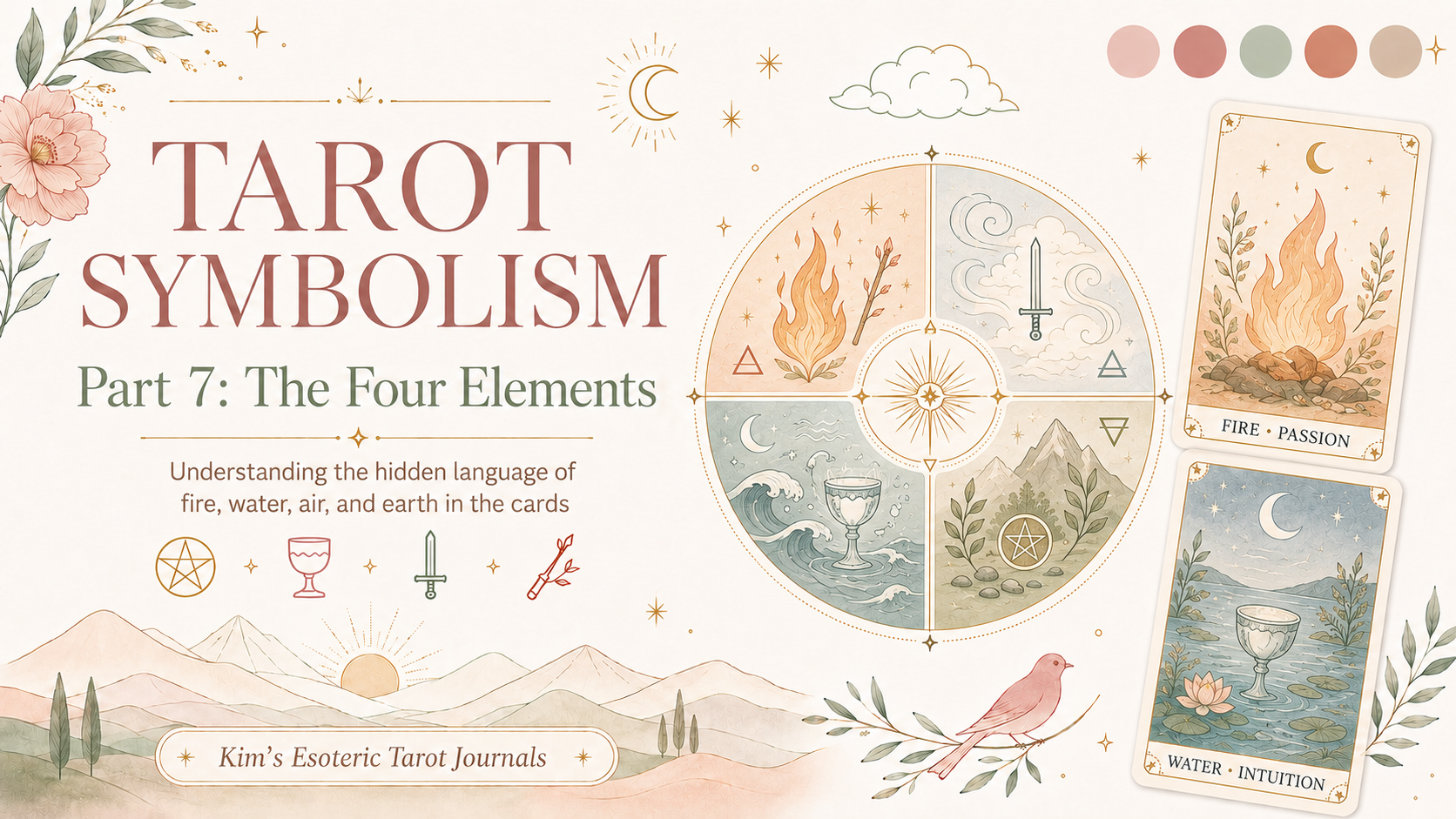
Tarot Symbolism Part 7 illustration showing fire, water, air, and earth symbols to explain how the four elements add meaning to tarot card interpretations.
The Four Elements in Tarot: Fire, Water, Air, and Earth each reveal a different layer of energy, emotion, thought, and stability within the cards.

Tarot Symbolism 107: Fire, Water, Air, and Earth in the Cards

We have worked through six layers of tarot symbolism so far: numerology, color, direction and body language, clouds and weather, animals, and plants and flowers. Today we are covering the layer that sits underneath all of the others: the four elements. Fire, Water, Air, and Earth are the foundation the entire tarot deck is built on. Understanding them does not just help you read individual symbols. It helps you understand why the deck is structured the way it is.

Every one of the four suits in the Minor Arcana is assigned to an element, and that assignment shapes every card in that suit from the Ace all the way through the King. The elements also appear visually throughout the Major Arcana in ways that most people walk right past. Once you know what to look for, you will start to see elemental language running through every card in the deck.

The Four Elements and the Four Suits

Here is the core assignment every tarot reader works from. These are not arbitrary. Each element was chosen because its essential qualities match the territory its suit covers.

ElementSuitCore EnergyWhat It Governs
FireWandsPassion and willAmbition, creativity, inspiration, drive, and the spark that starts things
WaterCupsFeeling and flowEmotions, relationships, intuition, dreams, and the inner life
AirSwordsThought and truthThe mind, communication, conflict, clarity, and the double edge of intellect
EarthPentaclesMatter and formMoney, work, the body, physical security, and the tangible results of effort

This is why I always tell beginners to learn the elements before they try to memorize individual card meanings. If you know that Swords belong to Air, you already know that every Swords card will have something to do with the mind, with thought, with communication, or with conflict. That is fourteen cards you understand before you have looked at a single one of them individually. The element gives you the territory. The number or court rank tells you where in that territory you are.

How the Elements Appear Visually

Beyond the suit system, the four elements show up as visual details throughout the deck. Here is a quick reference for the most common elemental signs to look for in the imagery itself.

Visual SignElementWhat to Look For
Flames or torchesFireActive energy, transformation, urgency, or creative force at work
Rivers, rain, or seaWaterEmotional currents, the unconscious, intuition, or situations in flow
Clouds, wind, or birdsAirMental activity, communication, shifting conditions, or ideas in motion
Mountains or stoneEarthStability, permanence, challenge requiring effort, or things built to last
Wands or staffsFireInitiative, personal power, and the will to create or lead
Cups or vesselsWaterEmotional content, what is being held, offered, or poured out
Swords or bladesAirIntellect, conflict, truth-telling, and the consequences of clear thinking
Coins or discsEarthResources, material value, work in progress, and tangible outcomes

The Elements in the Major Arcana

The Major Arcana does not belong to any single suit, but elemental energy runs through it constantly. The Emperor is deeply associated with Fire in its commanding, initiating energy, even though no flames appear in the card. The High Priestess is Water through and through: still, deep, inward, and concerned with what lies beneath the surface. The Fool steps into Air the moment he leaps, carried by wind, ungrounded, entirely in the realm of possibility. The Hierophant and the World both carry strong Earth associations: structured, established, and concerned with the tangible forms that things take in the world.

You do not need to memorize every elemental association in the Major Arcana before you start reading. But when a Major card feels unclear, asking yourself which element is most present in its imagery is often the fastest way back to the card’s essential meaning.

Quick Examples

The Three of Wands shows a figure standing on high ground, watching ships cross open water. The wands themselves are Fire, and the figure’s posture is forward-looking and expansive. But the water below represents something the Fire energy must work with or move across. The card is not just about ambition and vision. It is about what Fire looks like when it meets the larger world and has to navigate it. The elemental contrast in the image is part of the meaning.

The Queen of Cups sits at the edge of the sea, holding an ornate covered cup. Everything in her card is Water: her throne, the sea behind her, the clouds, the cup she holds but does not open. She is entirely in her element, which is why she represents emotional mastery rather than emotional struggle. A court card sitting comfortably within its own element is almost always a card about someone who knows their own nature well.

The Five of Swords has clouds in a disturbed sky and a figure holding three swords while two others walk away. The Air element is present throughout: the swords, the unsettled sky, the sense that something has been said that cannot be unsaid. The conflict in this card is not physical. It is intellectual and communicative, which is exactly what Air conflict looks like.

The Ten of Pentacles shows a multigenerational family scene in front of an archway covered in pentacles. The Earth element is everywhere: the stone architecture, the settled domestic scene, the weight of accumulated material success. The card does not need flames or water or wind. It needs permanence, and Earth provides it completely.

How to Use This When You Read

When you look at a card, try running a quick elemental check before you reach for a specific meaning:

•  Which element does this card’s suit belong to, and what does that tell you about the territory the situation lives in?

•  What elemental imagery is visible in the card, and does it reinforce or complicate the suit’s element?

•  Is one element dominating your spread, or are all four represented?

•  Are any elements completely absent from your spread?

A spread dominated by one element is always worth noting. A reading full of Fire cards is telling you something about energy, urgency, and creative or passionate force driving the situation. A reading full of Water cards is pointing toward an emotionally complex situation where feelings are doing most of the work. A reading with very little Earth is often one where the practical, tangible aspects of a situation have not been addressed yet.

The four elements are the grammar of tarot. Every other layer of symbolism we have covered in this series builds on top of them. Keep them in mind as you work through the remaining parts of this series, because they will show up again in the celestial symbols, the landscapes, and the repeated patterns we still have to cover.

Coming Up Next

Next we look upward again, this time at celestial symbols: the sun, the moon, the stars, and the planets that appear throughout the Rider-Waite deck. Celestial imagery carries a specific kind of symbolic weight that is different from the weather and atmosphere we covered in Part 4, and it is worth giving it its own dedicated space. After celestial symbols, the series continues through clothing, objects, landscapes and buildings, and repeated symbols.

Have you started thinking about the elements in your readings? If so, what are your thoughts?

Tarot readings are intended for adults age 18 and older and are provided for entertainment and personal reflection. Tarot should not replace professional medical, legal, mental health, or financial advice.

© 2026 Kim’s Esoteric Tarot Journals. All rights reserved.